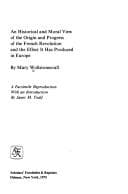
An historical and moral view of the origin and progress of the French Revolution; and the effect it has produced in EuropeWollstonecraft, Mary
Philosophy
An historical and moral view of the origin and progress of the French Revolution; and the effect it has produced in Europe
Wollstonecraft, Mary
France -- History -- Revolution, 1789-1799 -- Causes
At this glorious era, the toleration of religious opinions in America,
which the spirit of the times, when that continent was peopled with
persecuted europeans, produced, aided, not a little, to diffuse these
rational sentiments, and exhibited the phenomenon of a government
established on the basis of reason and equality. The eyes of all Europe
were watchfully fixed on the practical success of this experiment in
political science; and whilst the crowns of the old world were drawing
into their focus the hard-earned recompense of the toil and care of the
simple citizens, who lived detached from courts, deprived of the
comforts of life, the just reward of industry, or, palsied by
oppression, pined in dirt and idleness; the anglo-americans appeared to
be another race of beings, men formed to enjoy the advantages of
society, and not merely to benefit those who governed; the use to which
they had been appropriated in almost every state; considered only as the
ballast which keeps the vessel steady, necessary, yet despised. So
conspicuous in fact was the difference, that, when, frenchmen became the
auxiliaries of those brave people, during their noble struggle against
the tyrannical and inhuman ambition of the british court, it imparted to
them that stimulus, which alone was wanting to give wings to freedom,
who, hovering over France, led her indignant votaries to wreak their
vengeance on the tottering fabric of a government, the foundation of
which had been laid by benighted ignorance, and it’s walls cemented by
the calamities of millions that mock calculation—and, in it’s ruins a
system was entombed, the most baneful to human happiness and virtue.
America fortunately found herself in a situation very different from all
the rest of the world; for she had it in her power to lay the first
stones of her government, when reason was venturing to canvass
prejudice. Availing herself of the degree of civilization of the world,
she has not retained those customs, which were only the expedients of
barbarism; or thought that constitutions formed by chance, and
continually patched up, were superiour to the plans of reason, at
liberty to profit by experience.
When society was first regulated, the laws could not be adjusted so as
to take in the future conduct of it’s members, because the faculties of
man are unfolded and perfected by the improvements made by society:
consequently the regulations established as circumstances required were
very imperfect. What then is to hinder man, at each epoch of
civilization, from making a stand, and new modelling the materials, that
have been hastily thrown into a rude mass, which time alone has
consolidated and rendered venerable?
Public-domain text, read in full here on John Shaqi.
Reviews
Reviews
No reviews yet
Be the first to share your thoughts on this work.
Join the Discussion
Join the discussion
Sign in to leave a comment or review.
Sign InorCreate an account