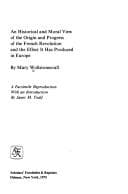
An historical and moral view of the origin and progress of the French Revolution; and the effect it has produced in EuropeWollstonecraft, Mary
Philosophy
An historical and moral view of the origin and progress of the French Revolution; and the effect it has produced in Europe
Wollstonecraft, Mary
France -- History -- Revolution, 1789-1799 -- Causes
When society was first subjugated to laws, probably by the ambition of
some, and the desire of safety in all, it was natural for men to be
selfish, because they were ignorant how intimately their own comfort was
connected with that of others; and it was also very natural, that
humanity, rather the effect of feeling than of reason, should have a
very limited range. But, when men once see, clear as the light of
heaven,—and I hail the glorious day from afar!—that on the general
happiness depends their own, reason will give strength to the fluttering
wings of passion, and men will “_do unto others, what they wish they
should do unto them_.”
What has hitherto been the political perfection of the world? In the two
most celebrated nations it has only been a polish of manners, an
extension of that family love, which is rather the effect of sympathy
and selfish passions, than reasonable humanity. And in what has ended
their so much extolled patriotism? In vain glory and barbarity—every
page of history proclaims. And why has the enthusiasm for virtue thus
passed away like the dew of the morning, dazzling the eyes of it’s
admirers? Why?—because it was factitious virtue.
During the period they had to combat against oppression, and rear an
infant state, what instances of heroism do not the annals of Greece and
Rome display! But it was merely the blaze of passion, “live smoke;” for
after vanquishing their enemies, and making the most astonishing
sacrifices to the glory of their country, they became civil tyrants, and
preyed on the very society, for whose welfare it was easier to die, than
to practise the sober duties of life, which insinuate through it the
contentment that is rather felt than seen. Like the parents who forget
all the dictates of justice and humanity, to aggrandize the very
children whom they keep in a state of dependence, these heroes loved
their country, because it was their country, ever showing by their
conduct, that it was only a part of a narrow love of themselves.
It is time, that a more enlightened moral love of mankind should
supplant, or rather support physical affections. It is time, that the
youth approaching manhood should be led by principles, and not hurried
along by sensations—and then we may expect, that the heroes of the
present generation, still having their monsters to cope with, will
labour to establish such rational laws throughout the world, that men
will not rest in the dead letter, or become artificial beings as they
become civilized.
Public-domain text, read in full here on John Shaqi.
Reviews
Reviews
No reviews yet
Be the first to share your thoughts on this work.
Join the Discussion
Join the discussion
Sign in to leave a comment or review.
Sign InorCreate an account