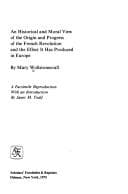
An historical and moral view of the origin and progress of the French Revolution; and the effect it has produced in EuropeWollstonecraft, Mary
Philosophy
An historical and moral view of the origin and progress of the French Revolution; and the effect it has produced in Europe
Wollstonecraft, Mary
France -- History -- Revolution, 1789-1799 -- Causes
Another observation, also, naturally occurs; for it is just to remark,
as a proof of the crudeness of the political notions, not to mention
principles, of these legislators, that all talked of _sacrifices_, and
boasted of generosity, when they were only doing common justice, and
making the obvious practical comment on the declaration of rights, which
they had passed in the morning.—If such were the rights of man—they were
more or less than men, who withheld them; and the resignation, rather a
resumption of their reason than a sacrifice of their property, was
called for, the moment they acknowledged the sovereignty of the people
by becoming their representatives.
It is very possible, that the next morning the different parties could
scarcely believe, that they had more than the imperfect recollection of
a dream in their heads. So quick, indeed, had been the determinations of
the meeting, which encroached on the midnight hour, that they had not
the sober cast of thought to give them dignity. They seem in reality to
have been mostly the effect of passion, of ambition, or a vain desire of
vengeance; for those who were led only by enthusiasm, and the vanity of
the moment, esteemed their conduct as highly extravagant, when they had
time to cool. But the commons, who had the deepest views, knew to what
they had urged them, and would not let them recede.
It is true, the abolition of these privileges and powers had been
strictly enjoined, in the instructions given to the deputies by their
constituents; but, it is doubtful, whether they would have been attended
to, had not the most sagacious foreseen, that the neglect might occasion
a civil war. Knowing, that then property would not be cautiously
respected, they began by attacking that of their presumptuous
adversaries; and actually surprised the assembly into the unanimous
renunciation of all revenues arising from feudal dues, and even into the
abolition of tithes. The nobility, also, who saw, that they should gain
more by the suppression of tithes, than they should lose by the
sacrifice of the obnoxious manorial fees, came into the same system. The
steps likewise taken to increase the salaries of the indigent clergy,
the most numerous part of the body in the assembly, secured their
influence. And by destroying the monopoly of municipal and judicial
employments, the support of the cities was obtained.—Thus the national
assembly, without a struggle, found itself omnipotent. Their only
enemies were individuals, seemingly of importance, it is true, as they
had been accustomed to lead the great corporate bodies; but what was
their empire, when all their former subjects were withdrawn from their
control? of these enemies, the church dignitaries were of the most
consequence; but, after the confiscation of ecclesiastical property, it
would have been impossible for the court, even supposing a
counter-revolution, to provide for them; as they would have been a dead
weight on the royalists.
Public-domain text, read in full here on John Shaqi.
Reviews
Reviews
No reviews yet
Be the first to share your thoughts on this work.
Elsewhere in the archive
Join the Discussion
Join the discussion
Sign in to leave a comment or review.
Sign InorCreate an account