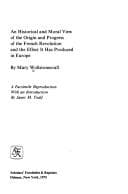
An historical and moral view of the origin and progress of the French Revolution; and the effect it has produced in EuropeWollstonecraft, Mary
Philosophy
An historical and moral view of the origin and progress of the French Revolution; and the effect it has produced in Europe
Wollstonecraft, Mary
France -- History -- Revolution, 1789-1799 -- Causes
The constitutional committee had given it as their opinion, that the
contested _veto_ did not concern the national assembly then existing;
which, being a constituting body, it was their duty to see that the
constitution was accepted, not sanctioned. This report carries with it
an air of imbecility, which renders it almost incredible: for, if the
assembly were determined to oblige the king to accept their decrees,
they had better have told him so with becoming dignity, and made
provision for his retiring from a post in which he was useless. Instead
of this, he was in a manner shuffled off the throne; and treated with
cruelty as well as contempt. It would have been at least ingenuous, and
might be deemed magnanimous, had they allowed him to retire with a third
of the stipend, which they afterwards voted him, when he continued to
appear like a theatrical king, only to excite the pity of the vulgar,
and to serve as a pretext for the despots of Europe to urge in
justification of their interference. The liberating an imprisoned
monarch was a plausible motive, though the real one was obviously to
stop the progress of principles, which, once permitted to extend
themselves, would ultimately sap the foundation of their tyranny, and
overturn all the courts in Europe. Pretending then only to have in view
the restoration of order in France, and to free an injured king, they
aimed at crushing the infant brood of liberty.
Similar sentiments must have occurred to every thinking person, who ever
seriously reflected on the conduct of the germanic courts, which has
actually destroyed the tranquillity of Europe for centuries past. War is
the natural consequence of their wretched systems of government.—They
are supported by military legions; and without wars they could not have
veteran soldiers. Their aggrandisement then, and half-lived pleasures,
cast in a mould of ceremony, spring out of the miseries, and are
fostered by the blood of human beings; whom they have sacrificed with as
much _sang froid_, sending them in herds to slaughter, as the
hard-hearted savage romans viewed the horrid spectacle of their
prize-fighters; from the bare idea of which the mind turns, disgusted
with the whole empire, and particularly with the government that dared
to boast of it’s heroism and respect for justice, when not only
tolerating, but encouraging such enormities.
Public-domain text, read in full here on John Shaqi.
Reviews
Reviews
No reviews yet
Be the first to share your thoughts on this work.
Elsewhere in the archive
Join the Discussion
Join the discussion
Sign in to leave a comment or review.
Sign InorCreate an account