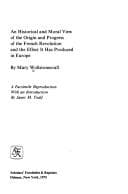
An historical and moral view of the origin and progress of the French Revolution; and the effect it has produced in EuropeWollstonecraft, Mary
Philosophy
An historical and moral view of the origin and progress of the French Revolution; and the effect it has produced in Europe
Wollstonecraft, Mary
France -- History -- Revolution, 1789-1799 -- Causes
To the sympathizing princes of the continent, therefore, the king should
have been given up; or, if it were necessary to humour the prejudice of
the nation, and still suffer frenchmen to have a most christian king, or
_grand monarque_, to amuse them by devouring capons or partridges before
them; it would have been but just, both in reason and policy, to have
allowed him such a portion of liberty and power, as would have formed a
consistent government. This would have prevented those clamours, which
were sure to draw together an host of enemies, to impede the settlement
of rational laws; flowing from a constitution, that would peaceably have
undermined despotism, had it been allowed gradually to change the
manners of the people. Though had this power been granted, it might have
been productive perhaps of great inconveniences; as it is not likely,
that a court accustomed to exercise unbridled sway would contentedly
have co-operated with the legislature, when possessing only reasonable
prerogatives.
Some apprehensions of this kind may have occurred to the assembly:
though it rather appears, that they were either influenced by a
ridiculous pride, not being willing to take the british constitution, so
far as it respected the prerogative, for their model; or intimidated by
the people, who, during the long debate, had outrageously expressed
their will, and even handed about a list of proscriptions, in which the
_vetoists_ were denounced as traitors worthy of death. Be this as it
may, they determined on a half-way measure, that irritated the court
without appeasing the people. Having previously decreed, that the
national assembly should be permanent, that is always existing, instead
of being dissolved at the close of every session, they resolved, that
the _veto_ of the king should suspend the enaction of a law only during
two legislatures. ‘The wisdom of this law,’ says Rabaud, ‘was
universally acknowledged:’ though the folly of it rather merited
universal reprobation.
From the manner indeed, in which the assembly was constituted, it was to
be dreaded, that it’s members would not long sustain the dignity, with
which they commenced the career of their business: because the party,
that opposed with such bitterness the junction of the three orders,
still opposing with rancorous heat, and wily stratagems, every measure
proposed by the really patriotic members, were indirectly seconded by
the insincere and wavering; who, having no motive to govern their
conduct, but the most detestable selfishness, the offspring of vanity or
avarice, always took the side best calculated to gratify the crude
wishes of the multitude. And this unyoked multitude, now suddenly
initiated into the science of civil and natural rights, all become
consummate politicians, began to control the decisions of a divided
assembly, rendered timid by intestine broils.
Public-domain text, read in full here on John Shaqi.
Reviews
Reviews
No reviews yet
Be the first to share your thoughts on this work.
Elsewhere in the archive
Join the Discussion
Join the discussion
Sign in to leave a comment or review.
Sign InorCreate an account