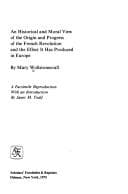
An historical and moral view of the origin and progress of the French Revolution; and the effect it has produced in EuropeWollstonecraft, Mary
Philosophy
An historical and moral view of the origin and progress of the French Revolution; and the effect it has produced in Europe
Wollstonecraft, Mary
France -- History -- Revolution, 1789-1799 -- Causes
It is, perhaps, the characteristic of vanity, to become enamoured with
ideas, in proportion as they were remote from it’s conception, until
brought to the mind by causes so natural, as to induce it to believe,
that they are the happy and spontaneous flow of it’s own prolific brain.
Their splendour then eclipsing his judgment, the man is hurried on by
enthusiasm and self-sufficiency, like a ship at sea, without ballast or
helm, by every breath of wind: and, to carry the comparison still
further, should a tempest chance to rise in the state, he is swallowed
up in the whirlpools of confusion, into the very midst of which his
conceit has plunged him; as the vessel, that was not prepared to stem
the violence of a hurricane, is buried in the raging surge.
The occasions of remarking, that frenchmen are the vainest men living,
often occur, and here it must be insisted on; for no sooner had they
taken possession of certain philosophical truths, persuading themselves,
that the world was indebted to them for the discovery, than they seem to
have overlooked every other consideration, but their adoption. Much evil
has been the consequence; yet France is certainly highly indebted to the
national assembly for establishing many constitutional principles of
liberty, which must greatly accelerate the improvement of the public
mind, and ultimately produce the perfect government, that they vainly
endeavoured to construct immediately with such fatal precipitation.
The consideration of several other articles of the constitution was
continually interrupted, and not more by the variety of business, which
came under the cognizance of the assembly, than by the want of a proper
arrangement of them. Much time was lost in disputing about the choice of
subjects of deliberation; and the order in which they ought to proceed.
The business of the day was perpetually obliged to give place to
episodical scenes; and men, who came prepared to discuss one question,
being obliged to turn to another, lost in some measure the benefit of
reflection, and the energy, so different from the enthusiasm of the
moment, with which a man supports a well digested opinion.
Public-domain text, read in full here on John Shaqi.
Reviews
Reviews
No reviews yet
Be the first to share your thoughts on this work.
Elsewhere in the archive
Join the Discussion
Join the discussion
Sign in to leave a comment or review.
Sign InorCreate an account