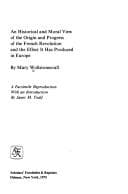
An historical and moral view of the origin and progress of the French Revolution; and the effect it has produced in EuropeWollstonecraft, Mary
Philosophy
An historical and moral view of the origin and progress of the French Revolution; and the effect it has produced in Europe
Wollstonecraft, Mary
France -- History -- Revolution, 1789-1799 -- Causes
Contemplating then these stupendous events with the cool eye of
observation, the judgement, difficult to be preserved unwarped under the
pressure of the calamitous horrours produced by desperate and enraged
factions, will continually perceive that it is the uncontaminated mass
of the french nation, whose minds begin to grasp the sentiments of
freedom, that has secured the equilibrium of the state; often tottering
on the brink of annihilation; in spite of the folly, selfishness,
madness, treachery, and more fatal mock patriotism, the common result of
depraved manners, the concomitant of that servility and voluptuousness
which for so long a space of time has embruted the higher orders of this
celebrated nation.
By thus attending to circumstances, we shall be able to discern clearly
that the revolution was neither produced by the abilities or intrigues
of a few individuals; nor was the effect of sudden and short-lived
enthusiasm; but the natural consequence of intellectual improvement,
gradually proceeding to perfection in the advancement of communities,
from a state of barbarism to that of polished society, till now arrived
at the point when sincerity of principles seems to be hastening the
overthrow of the tremendous empire of superstition and hypocrisy,
erected upon the ruins of gothic brutality and ignorance.
CONTENTS.
_BOOK I._
CHAPTER I.
_Introduction. Progress of society. End of government. Rise of
political discussion amongst the french. Revolution in
America. Virtue attempted to be built on false principles.
The croisades, and the age of chivalry. Administration of
Richelieu, and of Cardinal Mazarin. Theatrical
entertainments, and dramatic poets of the
french—Moliere,—Corneille,—Racine. Louis XIV. The
regency.—Louis XV._ page 1.
CHAP. II.
_Marie-Antoinette. Louis XVI. Administration of Necker, and of
Calonne. Notables convened. Calonne disgraced,—and obliged to
flee the kingdom. His character. Causes of the enslaved state
of Europe._ p. 33.
CHAP. III.
_Administration of de Brienne. Dissolution of the notables.
Land tax and stamp duty recommended by them, but refused to
be sanctioned by the parliament. Bed of justice. The
parliament banished to Troyes,—but soon compromised for its
recall. Struggles of the court party to prevent the
convocation of the states-general. Banishment of the duke of
Orleans, and two spirited members of the parliament. Cour
pléniere. Remarks on the parliaments. Imprisonment of the
members. Deputies of the Province of Britanny sent to the
Bastille. The soldiery let loose upon the people._ p. 48.
CHAP. IV.
Public-domain text, read in full here on John Shaqi.
Reviews
Reviews
No reviews yet
Be the first to share your thoughts on this work.
Join the Discussion
Join the discussion
Sign in to leave a comment or review.
Sign InorCreate an account