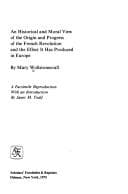
An historical and moral view of the origin and progress of the French Revolution; and the effect it has produced in EuropeWollstonecraft, Mary
Philosophy
An historical and moral view of the origin and progress of the French Revolution; and the effect it has produced in Europe
Wollstonecraft, Mary
France -- History -- Revolution, 1789-1799 -- Causes
_Necker recalled. His character. Notables convened a second
time. Coalition of the nobility and clergy in defence of
their privileges. Provincial assemblies of the people.
Political publications in favour of the tiers-etat. General
reflections on reform,—on the present state of Europe,—and on
the revolution in France._ p. 59.
_BOOK II._
CHAP. I.
_Retrospective view of grievances in France—the nobles—the
military—the clergy—the farmers general. Election of deputies
to the states-general. Arts of the courtiers. Assembly of the
states. Riots excited at Paris. Opening of the
states-general. The king’s speech. Answer to it by the keeper
of the seals. Speech of Mr. Necker. Contest respecting the
mode of assembling. Tacit establishment of the liberty of the
press. Attempt of the court to refrain it. The deputies
declare themselves a national assembly._ p. 75.
CHAP. II.
_The national assembly proceed to business. Opposition of the
nobles, bishops, and court. A séance royale proclaimed, and
the hall of the assembly surrounded by soldiers. The members
adjourn to the tennis-court, and vow never to separate till a
constitution should be completed. The majority of the clergy
and two of the nobles join the commons. Séance royale. The
king’s speech. Spirited behaviour of the assembly. Speech of
Mirabeau. Persons of the deputies declared inviolable.
Minority of the nobles join the commons. At the request of
the king the minority of the clergy do the same,—and are at
length followed by the majority of the nobles. Character of
the queen of France,—of the king,—and of the nobles. Lectures
on liberty at the palais royal. Paris surrounded by troops.
Spirit of liberty infused into the soldiers. Eleven of the
french guards imprisoned because they would not fire on the
populace, and liberated by the people. Remonstrance of the
national assembly. The king proposes to remove the assembly
to Noyon, or Soissons. Necker dismissed. City militia
proposed. The populace attacked in the garden of the
Thuilleries by the prince of Lambesc. Nocturnal orgies at
Versailles._ p. 109.
CHAP. III.
Public-domain text, read in full here on John Shaqi.
Reviews
Reviews
No reviews yet
Be the first to share your thoughts on this work.
Join the Discussion
Join the discussion
Sign in to leave a comment or review.
Sign InorCreate an account