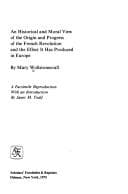
An historical and moral view of the origin and progress of the French Revolution; and the effect it has produced in Europe — John Shaqi
An historical and moral view of the origin and progress of the French Revolution; and the effect it has produced in EuropeWollstonecraft, Mary
Philosophy
An historical and moral view of the origin and progress of the French Revolution; and the effect it has produced in Europe
Wollstonecraft, Mary
France -- History -- Revolution, 1789-1799 -- Causes
Her character thus formed, when she became absolute mistress, the court
of the passive Louis, not only the most dissolute and abandoned that
ever displayed the folly of royalty, but audaciously negligent with
respect to that attention to decency, which is necessary to delude the
vulgar, was deserted by all persons, who had any regard for their moral
character, or the decorum of appearances. Constrained by the
_etiquette_, which made the principal part of the imposing grandeur of
Louis XIV, the queen wished to throw aside the cumbersome brocade of
ceremony, without having discernment enough to perceive, that it was
necessary to lend mock dignity to a court, where there was not
sufficient virtue, or native beauty, to give interest or respectability
to simplicity. The harlot is seldom such a fool as to neglect her
meretricious ornaments, unless she renounces her trade; and the
pageantry of courts is the same thing on a larger scale. The lively
predilection, likewise, of the queen for her native country, and love
for her brother Joseph, to whom she repeatedly sent considerable sums,
purloined from the public, tended greatly to inspire the most ineffable
contempt for royalty, now stript of the frippery which had concealed
it’s deformity: and the sovereign disgust excited by her ruinous vices,
completely destroying all reverence for that majesty, to which power
alone lent dignity, contempt soon produced hatred.
The infamous transaction of the necklace, in which she was probably the
dupe of the knaves she fostered, exasperated also both the nobility and
the clergy; and, with her messalinian feasts at _Trianon_, made her the
common mark of ridicule and satire.
The attention of the people once roused was not permitted to sleep; for
fresh circumstances daily occurred, to give a new spring to discussions,
that the most iniquitous and heavy taxes brought home to every bosom;
till the extravagance of the royal family became the general subject of
sharpening execrations.
The king, who had not sufficient resolution to support the
administration of Turgot, whom his disposition for moderation had
chosen, being at a loss what measures to take, called to the helm the
plausible Necker. He, only half comprehending the plans of his able
predecessor, was led by his vanity cautiously to adopt them; first
publishing his _Comte-rendu_, to clear the way to popularity. This work
was read with astonishing rapidity by all ranks of men; and alarming the
courtiers, Necker was, in his turn, dismissed. He retired to write his
observations on the administration of the finances, which kept alive the
spirit of inquiry, that afterwards broke the talisman of courts, and
showed the disenchanted multitude, that those, whom they had been taught
to respect as supernatural beings, were not indeed men—but monsters;
deprived by their station of humanity, and even sympathy.
Public-domain text, read in full here on John Shaqi.
Reviews
Reviews
No reviews yet
Be the first to share your thoughts on this work.
Join the Discussion
Join the discussion
Sign in to leave a comment or review.
Sign InorCreate an account