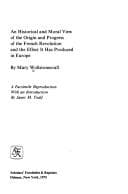
An historical and moral view of the origin and progress of the French Revolution; and the effect it has produced in EuropeWollstonecraft, Mary
Philosophy
An historical and moral view of the origin and progress of the French Revolution; and the effect it has produced in Europe
Wollstonecraft, Mary
France -- History -- Revolution, 1789-1799 -- Causes
The _notables_, once assembled, being sensible, that their conduct would
be inspected by an awakened public, now on the watch, scrupulously
examined into every national concern; and seriously investigated the
causes, that had produced the _deficit_, with something like the
independent spirit of freemen. To their inquiries, however, the minister
gave only the evasive reply, ‘that he had acted in obedience to the
pleasure of the king:’ when it was notorious to all Europe, that his
majesty was merely a cipher at Versailles; and even the accusation
brought against Calonne, by La Fayette, of exchanging the national
domains, and appropriating millions of it’s revenue to gratify the
queen, the count d’Artois, and the rest of the cabal, who kept him in
place, was generally believed. In fact, the state had been fleeced, to
support the unremitting demands of the queen; who would have dismembered
France, to aggrandize Austria, and pamper her favourites. Thus the court
conniving at peculation, the minister played a sure game; whilst the
honest labourer was groaning under a thousand abuses, and yielding the
solace of his industry, or the hoards, which youthful strength had
reserved for times of scarcity or decrepit age, to irritate the
increasing wants of a thoughtless, treacherous princess, and the avarice
of her unprincipled agents.
This artful, though weak, machiavelian politician suffered no other
person to approach the king; who, seduced into confidence by his
colloquial powers, could not avoid being dazzled by his plausible
schemes. He had, nevertheless, a powerful enemy to contend with, in M.
de Breteuil; who, having gratified some of the little passions of the
dauphine, during her first struggles for dominion, was now protected by
the absolute power of the queen. Endeavouring to measure his strength
with her’s, the minister was discomfited; and the whole swarm of
flatterers, who had partaken of the spoil of rapine, were instantly
alert to open the eyes of Louis, over which they had long been
scattering poppies, and soon convinced him of the perfidy of his
favourite; whilst the two privileged orders joined their forces, to
overwhelm their common enemy, attending to their vengeance at the very
time they followed the dictates of prudence.
The accusations of La Fayette served, perhaps, as the ostensible reason
with the public, and even with the king; yet it can hardly be supposed,
that they had any effect on the cabal, who invented, or connived at the
plans necessary to raise a continual supply for their pleasures. The
fact is, that, most probably being found unequal to the task, or no
longer choosing to be a docile instrument of mischief, he was thrown
aside as unfit for use.
Public-domain text, read in full here on John Shaqi.
Reviews
Reviews
No reviews yet
Be the first to share your thoughts on this work.
Join the Discussion
Join the discussion
Sign in to leave a comment or review.
Sign InorCreate an account