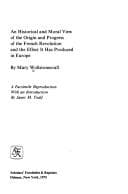
An historical and moral view of the origin and progress of the French Revolution; and the effect it has produced in EuropeWollstonecraft, Mary
Philosophy
An historical and moral view of the origin and progress of the French Revolution; and the effect it has produced in Europe
Wollstonecraft, Mary
France -- History -- Revolution, 1789-1799 -- Causes
Without canvassing Calonne’s intentions, which the most enlarged
charity, after his former extravagance, can scarcely suppose to have
been the interest of the people, moderate men imagined this project
might have been productive of much good; giving the french all the
liberty they were able to digest; and, warding off the tumults that have
since produced so many disastrous events, whilst coolly preparing them
for the reception of more, the effervescence of vanity and ignorance
would not have rendered their heads giddy, or their hearts savage. Yet
some sensible observers, on the contrary, rather adopted the opinion,
that as the people had discovered the magnitude of the _deficit_, they
were now persuaded, that a specific remedy was wanting, _a new
constitution_; to cure the evils, which were the excrescences of a
gigantic tyranny, that appeared to be draining away the vital juices of
labour, to fill the insatiable jaws of thousands of fawning slaves and
idle sycophants. But though the people might, for the present, have been
satisfied with this salutary reform, which would gradually have had an
effect, reasoning from analogy, that the financier did not take, into
his account, the nobility were not sufficiently enlightened to listen to
the dictates of justice or prudence. It had been, indeed, the system of
ministers, ever since Richelieu, to humble the nobles, to increase the
power of the court; and as the ministry, the generals, and the bishops,
were always noble, they aided to support the favourite, who depressed
the whole body, only for the chance of individual preferment. But this
bare-faced attempt to abolish their privileges raised a nest of hornets
about his ears, eager to secure the plunder on which they lived; for by
what other name can we call the pensions, places and even estates of
those who, taxing industry, rioted in idleness duty free[6]?
An approaching national bankruptcy was the ostensible reason assigned
for the convening of the _notables_ in 1787; but the convocation, in
truth, ought to be ascribed to the voice of reason, founded through the
organ of twenty-five millions of human beings, who, though under the
fetters of a detestable tyranny, felt, that the crisis was at hand, when
the rights of man, and his dignity ascertained were to be enthroned on
the eternal basis of justice and humanity.
Public-domain text, read in full here on John Shaqi.
Reviews
Reviews
No reviews yet
Be the first to share your thoughts on this work.
Join the Discussion
Join the discussion
Sign in to leave a comment or review.
Sign InorCreate an account