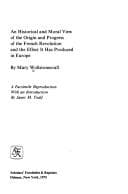
An historical and moral view of the origin and progress of the French Revolution; and the effect it has produced in EuropeWollstonecraft, Mary
Philosophy
An historical and moral view of the origin and progress of the French Revolution; and the effect it has produced in Europe
Wollstonecraft, Mary
France -- History -- Revolution, 1789-1799 -- Causes
Reflecting on the conduct of the tools of courts, we are enabled in a
great measure to account for the slavery of Europe; and to discover,
that it’s misery has not arisen more from the imperfection of
civilization, than from the fallacy of those political systems, which
necessarily made the favourite of the day a knavish tyrant, eager to
amass riches sufficient to save himself from oblivion, when the honours,
so hardly wrestled for, should be torn from his brow. Besides, whilst
ministers have found impunity in the omnipotence, which the seal of
power gave them, and in the covert fear of those who hoped one day to
enjoy the same emoluments, they have been led by the prevalence of
depraved manners, to the commission of every atrocious folly. Kings have
been the dupes of ministers, of mistresses, and secretaries, not to
notice sly valets and cunning waiting-maids, who are seldom idle; and
these are most venal, because they have least independence of character
to support; till in the circle of corruption no one can point out the
first mover. Hence proceeds the great tenacity of courts to support
them; hence originates their great objection to republican forms of
government, which oblige their ministers to be accountable for
delinquency; and hence, likewise, might be traced their agonizing fears
of the doctrine of civil equality.
CHAPTER III.
ADMINISTRATION OF DE BRIENNE. DISSOLUTION OF THE NOTABLES. LAND TAX AND
STAMP DUTY RECOMMENDED BY THEM, BUT REFUSED TO BE SANCTIONED BY THE
PARLIAMENT. BED OF JUSTICE. THE PARLIAMENT BANISHED TO TROYES,—BUT SOON
COMPROMISED FOR IT’S RECALL. STRUGGLES OF THE COURT PARTY TO PREVENT THE
CONVOCATION OF THE STATES-GENERAL. BANISHMENT OF THE DUKE OF ORLEANS,
AND TWO SPIRITED MEMBERS OF THE PARLIAMENT. COUR PLENIERE. REMARKS ON
THE PARLIAMENTS. IMPRISONMENT OF THE MEMBERS. DEPUTIES OF THE PROVINCE
OF BRITANNY SENT TO THE BASTILLE. THE SOLDIERY LET LOOSE UPON THE
PEOPLE.
After the dismission of Calonne, M. de Brienne, a man whose talents
Turgot had overrated, was now chosen by the queen, because he had
formerly seconded her views, and was still the obsequious slave of that
power, which he had long been courting, to obtain the so much envied
place of minister. Having taken more pains to gain the post than to
prepare himself to fulfil it’s functions, his weak and timid mind was in
a continual tumult; and he adopted with head-long confusion the taxes
proposed by his predecessor; because money must be had, and he knew not
where to turn to procure it by an unhacknied mode of extortion.
Public-domain text, read in full here on John Shaqi.
Reviews
Reviews
No reviews yet
Be the first to share your thoughts on this work.
Join the Discussion
Join the discussion
Sign in to leave a comment or review.
Sign InorCreate an account