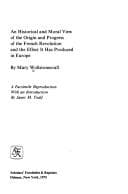
An historical and moral view of the origin and progress of the French Revolution; and the effect it has produced in EuropeWollstonecraft, Mary
Philosophy
An historical and moral view of the origin and progress of the French Revolution; and the effect it has produced in Europe
Wollstonecraft, Mary
France -- History -- Revolution, 1789-1799 -- Causes
The nobles and the clergy immediately rallied round the standard of
privileges, insisting, that France would be ruined, if their _rights_
were touched: and so true were they now to their insulated interest,
that all the committees into which the _notables_ were divided,
excepting that of which _monsieur_ was president, determined against
allowing the _tiers-etat_ that increase of power necessary to enable
them to be useful. Whilst, however, these disputes and cabals seemed to
promise no speedy determination, the people, weary of procrastination,
and disgusted with the obstacles continually thrown in the way of the
meeting of the states-general, by a court that was ever secretly at
work, to regain the trifling privileges, which it pretended to sacrifice
to the general good, began to assemble, and even to decide the previous
question, by deliberating together in several places. Dauphine set the
example; and the three orders uniting sketched a plan for the
organization of the whole kingdom, which served as a model for the other
provincial states, and furnished grounds for the constituent assembly to
work on when forming the constitution. Though the rumour was spread
abroad, the court, still so stupidly secure as not to see, that the
people, who at this period dared to think for themselves, would not now
be noosed like beasts, when strength is brought into subjection by
reason, beheld with wonder the arrival of deputations from different
quarters, and heard with astonishment the bold tones of men speaking of
their rights, tracing society to it’s origin, and painting with the most
forcible colours the horrid depredations of the old government. For
after the minds of men had been fatigued by the stratagems of the court,
the feeble measures of the minister, and the narrow, selfish views of
the parliaments, they examined with avidity the productions of a number
of able writers, who were daily pouring pamphlets from the press, to
excite the _tiers-etat_, to assert it’s rights on enlarged principles,
and to oppose vigorously the exorbitant claims of the privileged orders,
who stood up for ancient usurpations, as if they were the natural rights
of a particular _genus_ of man. Those of the abbé Sieyes and the marquis
de Condorcet were the most philosophical; whilst the unctuous eloquence
of Mirabeau softened these dry researches, and fed the flame of
patriotism.
In this posture of affairs, Necker, perceiving that the people were
grown resolute, prevailed on the council to decree, that the number of
the deputies of the _tiers-etat_ should be equal to that of the two
other orders taken together: but whether they were to vote by chambers,
or in the same body, was still left undetermined.
Public-domain text, read in full here on John Shaqi.
Reviews
Reviews
No reviews yet
Be the first to share your thoughts on this work.
Join the Discussion
Join the discussion
Sign in to leave a comment or review.
Sign InorCreate an account