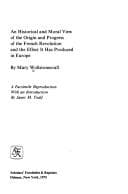
An historical and moral view of the origin and progress of the French Revolution; and the effect it has produced in EuropeWollstonecraft, Mary
Philosophy
An historical and moral view of the origin and progress of the French Revolution; and the effect it has produced in Europe
Wollstonecraft, Mary
France -- History -- Revolution, 1789-1799 -- Causes
Attention and applause, however, awaited Necker, though followed by
weariness and disgust. He spoke for three hours, introducing, with his
customary pomp of words, a number of trivial observations; trying thus
to escape, in a mist of rhetorical flourishes, from the subject he
feared to bring forward, because he was equally apprehensive of
offending the court, and desirous of maintaining his reputation with the
people. Not a word was uttered relative to the sole right of the
states-general to levy taxes, the first demand of the nation. And men
who for some time had been talking of nothing but liberty and reform,
were astonished, and dissatisfied, that he avoided all mention of a new
constitution. Leaning to the side of the privileged orders, he asserted,
that the mode of deliberating and voting in separate assemblies was the
pillar of the nation—yet, cautiously adding a salvo, to have a pretext
to use another language should it be necessary, he remarked, that
_sometimes_ it was better to poll. This ill-timed management naturally
displeased both parties, as is always the case, when men of weak,
compound characters, who have not the courage to act right, want
effrontery to brave the censure, that would follow an open avowal of
their undecided opinions; or rather, their determination to keep well
with the strongest. Dwelling on the arrangement of the finances, he
assured them, that a public bankruptcy might easily be avoided; and that
even the _deficit_, which had been exaggerated by France, and Europe,
was only fifty-six millions; and would appear of less consequence, when
they recollected, that, since _his_ administration, the revenue was
augmented twenty-five millions. It is true, that, on entering into
details, the greater part of this sum was found to be still in
perspective; and at the same time was to be raised by taxes, which all
good citizens hoped would soon disappear. In short, the french, after
applauding with rapture this brilliant bird’s-eye view, observed, with
the shrug of _sang froid_, ‘that these hypothetical resources were
merely faith and hope, on condition that they should be charitable.’
With respect to the abolishing of privileges, that warred with humanity,
he made use of some of the same species of jesuitical arguments, which
are employed by the opposers of the abolition of the infamous traffic
for slaves; that, as these privileges were a kind of property, it was
necessary to find out a compensation, an indemnity, before they could be
done away—with justice.
Public-domain text, read in full here on John Shaqi.
Reviews
Reviews
No reviews yet
Be the first to share your thoughts on this work.
Join the Discussion
Join the discussion
Sign in to leave a comment or review.
Sign InorCreate an account