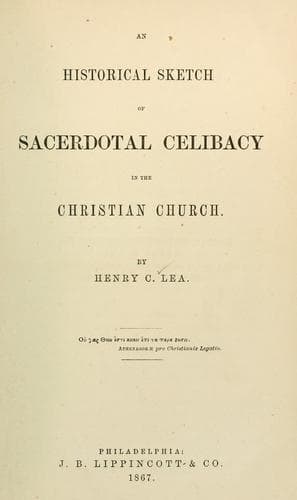
An Historical Sketch of Sacerdotal Celibacy in the Christian ChurchLea, Henry Charles
History
An Historical Sketch of Sacerdotal Celibacy in the Christian Church
Lea, Henry Charles
Catholic Church -- Clergy; Celibacy -- Catholic Church; Church history
For a century we hear nothing more of sacerdotal marriage—and yet it
may be doubted whether clerical morality had really been improved
by the well-meant reforms of Boniface. These were followed up by
Charlemagne with all his resistless energy, and the importance which
he attached to the subject is shown by an epistle of Adrian I. denying
certain assertions made to the Frankish sovereign, inculpating the
purity of the Roman clergy. Adrian, in defending his flock, assumes
that the object of the slanders can only have been to produce a quarrel
between himself and Charlemagne, who must evidently have made strong
representations on the subject to the Pontiff.[301] Under such pressure
perhaps there was something less of shameless licentiousness; the
episcopal chairs were no longer defiled by the cynical lubricity of
unworthy prelates; but in the mass of the clergy the passions, deprived
of all legitimate gratification, could not be restrained in a race so
little accustomed to self-control, and unchastity remained a corroding
ulcer which Charlemagne and Louis-le-Débonnaire vainly endeavored
to eradicate. The former, indeed, we find asking in 811 whether the
only difference between clerk and layman is that the former does not
bear arms and is not publicly married;[302] while Ghaerbald, Bishop
of Liége, a few years before had ordered that all priests maintaining
intercourse with their wives should be deprived of their benefices and
be subjected to penitence until death.[303]
It would be an unprofitable task to recapitulate the constantly
repeated legislation prohibiting the residence of women with the
clergy and repressing the disorders and irregularities of the monastic
establishments. It would be but a reiteration of the story already
related in previous centuries, and its only importance would be in
showing by the frequency of the edicts how utterly ineffectual they
were. When Louis-le-Débonnaire, in 826, decreed[304] that the seduction
of a nun was to be punished by the death of both the partners in guilt;
that the property of both was to be confiscated to the church, and that
the count in whose district the crime occurred, if he neglected its
prosecution, was to be degraded, deprived of his office, undergo public
penance, and pay his full wer-gild to the fisc, the frightful severity
of the enactment is the measure of the impossibility of effecting its
purpose, and of the inefficiency of the reformation which had been
so elaborately prepared and so energetically promulgated by Louis in
817.[305]
Public-domain text, read in full here on John Shaqi.
Reviews
Reviews
No reviews yet
Be the first to share your thoughts on this work.
Elsewhere in the archive
Join the Discussion
Join the discussion
Sign in to leave a comment or review.
Sign InorCreate an account