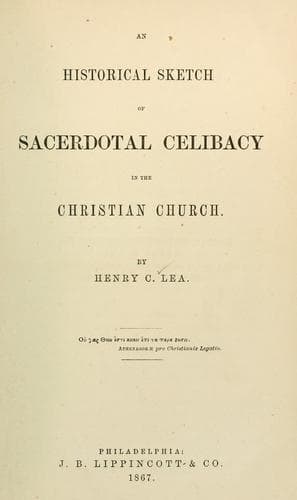
An Historical Sketch of Sacerdotal Celibacy in the Christian ChurchLea, Henry Charles
History
An Historical Sketch of Sacerdotal Celibacy in the Christian Church
Lea, Henry Charles
Catholic Church -- Clergy; Celibacy -- Catholic Church; Church history
But perhaps the most convincing evidence of the debased morality of the
clergy, and of the low standard which even the most zealous prelates
were forced to adopt, is to be found in a curious fabrication by the
authors of the False Decretals. The collection of decretals which they
put forth in the names of the early popes embodied their conception
of a perfect church establishment, as adapted to the necessities and
aspirations of the ninth century. While straining every point to
throw off all subjection to the temporal power, and to obtain for the
hierarchy full and absolute control over all ecclesiastical matters and
persons, they seem to have felt it necessary to relax in an important
point the rigor of the canons respecting sacerdotal purity. Gregory the
Great had proclaimed in the clearest and most definite manner the rule
that a single lapse from virtue condemned the sinner to irrevocable
degradation, and rendered him forever unfit for the ministry of the
altar.[306] Yet “Isidor Mercator” added to a genuine epistle of Gregory
a long passage elaborately arguing the necessity of forgiveness for
those who expiate by repentance the sin of impurity, “of which, among
many, so few are guiltless.”[307] The direct testimony is notable, but
not less so is the indirect evidence of the prevalent laxity which
could induce such a bid for popularity on the part of high churchmen
like those concerned in the Isidorian forgeries.
Evidence, also, is not wanting, that the denial of the appropriate and
healthful human affections led to the results which might be expected
of fearful and unnatural crimes. That the inmates of monasteries,
debarred from female society, occasionally abandoned themselves to the
worst excesses, or, breaking through all restraint, indulged in less
reprehensible but more open scandals, is proclaimed by Charlemagne, who
threatened to vindicate the outrage upon religion with the severest
punishment.[308] Nor were the female convents more successfully
regulated, for the council of Aix-la-Chapelle, in 836, states that
in many places they were rather brothels than houses of God; and it
shows how close a supervision over the spouses of Christ was thought
requisite when it proceeds to direct that nunneries shall be so built
as to have no dark corners in which scandals may be perpetrated out of
view.[309] The effect of these efforts may be estimated from a remark
in a collection of laws which bears the name of Erchenbald, Chancellor
of Charlemagne, but which is rather attributable to the close of the
ninth century, that the licentiousness of nuns commonly resulted in
a worse crime—infanticide;[310] and, as this is extracted textually
from an epistle of St. Boniface to Ethelbald, King of Mercia,[311]
it is presumable that the evil became notorious simultaneously with
the reform under the early Carlovingians, and continued unabated
throughout their dynasty. One device to subjugate nature, adopted in
Public-domain text, read in full here on John Shaqi.
Reviews
Reviews
No reviews yet
Be the first to share your thoughts on this work.
Elsewhere in the archive
Join the Discussion
Join the discussion
Sign in to leave a comment or review.
Sign InorCreate an account