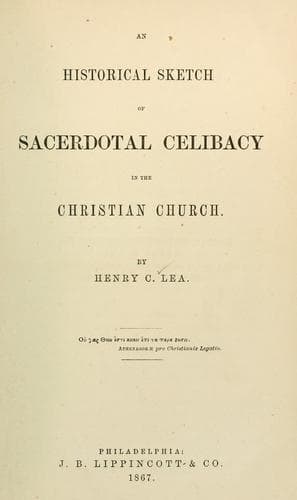
An Historical Sketch of Sacerdotal Celibacy in the Christian ChurchLea, Henry Charles
History
An Historical Sketch of Sacerdotal Celibacy in the Christian Church
Lea, Henry Charles
Catholic Church -- Clergy; Celibacy -- Catholic Church; Church history
the monasteries, was to let blood at stated intervals, in the hope
of reducing the system and thus mitigating the effects of prolonged
continence—a device prohibited by Louis-le-Débonnaire, but long
subsequently maintained as part of monastic discipline.[312] As regards
the secular clergy, even darker horrors are asserted by Theodulf,
Bishop of Orleans, and other prelates, who forbade to their clergy the
residence of mother, aunt, and sister, in consequence of the crimes so
frequently perpetrated with them at the instigation of the devil;[313]
and the truth of this hideous fact is unfortunately confirmed by the
declarations of councils held at various periods.[314]
If, under the external polish of Carlovingian civilization, such utter
demoralization existed, while the laws were enforced by the stern
vigor of Charlemagne, or the sensitive piety of Louis-le-Débonnaire,
it is easy to understand what was the condition of society when the
sons of the latter involved the whole empire in a ceaseless tumult of
civil war. Not only was the watchful care of the first two emperors
withdrawn, but the state was turned against itself, and rapine and
desolation became almost universal. The royal power was parcelled out,
by the rising feudal system, among a crowd of nobles whose energies
were solely directed to consolidating their position, and was chiefly
employed, as far as it affected the church, in granting abbeys and
other ecclesiastical dignities to worthless laymen, whose support
could only be secured by bribes which the royal fisc could no longer
supply. Pagan Danes and infidel Saracens were ravaging the fairest
provinces of the empire, and their blows fell with peculiar weight on
the representatives of a hated religion. For seventy years previous
to the treaty of Clair-sur-Epte no mass resounded in the walls of the
cathedral church of Coutances, so fierce and unremitting had been the
incursions of the Northmen. It is therefore no wonder that, as early
as 845, the bishops assembled at the council of Vernon confess that
their ecclesiastical authority is no longer sufficient to prevent the
marriage of monks and nuns and to suppress the crowds who escaped from
their convents and wandered over the country in licentiousness and
vagabondage. To restrain these disorders they are obliged to invoke
the royal power to cast into prison these reprobates and force them to
undergo canonical penance.[315]
Public-domain text, read in full here on John Shaqi.
Reviews
Reviews
No reviews yet
Be the first to share your thoughts on this work.
Elsewhere in the archive
Join the Discussion
Join the discussion
Sign in to leave a comment or review.
Sign InorCreate an account