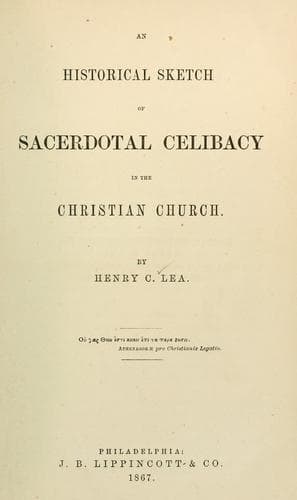
An Historical Sketch of Sacerdotal Celibacy in the Christian ChurchLea, Henry Charles
History
An Historical Sketch of Sacerdotal Celibacy in the Christian Church
Lea, Henry Charles
Catholic Church -- Clergy; Celibacy -- Catholic Church; Church history
During this period of anarchy and lawlessness, the church was
skilfully emancipating itself from subjection to the temporal power,
and was laying the foundation of that supremacy which was eventually
to dominate Christendom. While its aspirations and ambitions were
thus worldly, and its ranks were recruited from a generation trained
under such influences, it is easy to believe that the disorders which
Charlemagne himself could not repress, grew more and more flagrant.
Even the greatly augmented power of the papacy added to the increasing
license, although Nicholas I. in 861 had ordered the deposition and
degradation of all priests convicted of immorality,[316] for the
appellate jurisdiction claimed by Rome gave practical immunity to
those against whom the enforcement of the canons was attempted. About
the year 876, Charles-le-Chauve, in a spirited argument against the
pretensions of the popes, calls attention specially to the exemption
thus afforded to unchaste priests, who, after due conviction by their
bishops, obtained letters from Rome overruling the judgments; the
distance and dangers of the journey precluding the local authorities
from supporting their verdicts by sending commissioners and witnesses
to carry on a second trial beyond the Alps.[317]
This shows that the effort to enforce purity was not as yet
abandoned, however slender may have been the success in eradicating
an evil so general and so deeply rooted. The nominal punishment for
unchastity—loss of benefice and deposition—was severe enough to induce
the guilty to hide their excesses with care, when they chanced to have
a bishop who was zealous in the performance of his duties. Efforts at
concealment, moreover, were favored by the forms of judicial procedure,
which were such as to throw every difficulty in the way of procuring
a conviction, and to afford, in most cases, practical immunity for
sin, unless committed in the most open and shameless manner. Hincmar,
Archbishop of Rheims, the leading ecclesiastic of his day, whose
reputation for learning and piety would have rendered him one of
the lights of the church, had not his consistent opposition to the
innovations of the papacy caused his sanctity to be questioned in Rome,
has left us elaborate directions as to the forms of prosecution in such
matters. Notwithstanding his earnest exhortations and arguments in
favor of the most ascetic purity, he discourages investigation by means
of neighbors and parishioners, or irreverent inquiries on the subject.
Only such testimony was admissible as the laws allowed, and the laws
were very strict as to the position and character of witnesses. In
addition to the accusers themselves, seven witnesses were necessary.
Of these, one was required to substantiate the oaths of the rest by
undergoing the ordeal, thus exposing himself and all his fellows to
the heavy penalties visited on perjury, upon the chance of the red-hot
iron or cold-water trial, administered, perhaps, by those interested
Public-domain text, read in full here on John Shaqi.
Reviews
Reviews
No reviews yet
Be the first to share your thoughts on this work.
Elsewhere in the archive
Join the Discussion
Join the discussion
Sign in to leave a comment or review.
Sign InorCreate an account