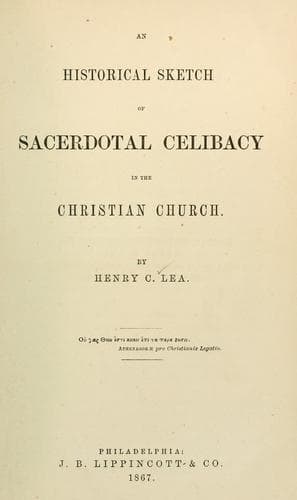
An Historical Sketch of Sacerdotal Celibacy in the Christian ChurchLea, Henry Charles
History
An Historical Sketch of Sacerdotal Celibacy in the Christian Church
Lea, Henry Charles
Catholic Church -- Clergy; Celibacy -- Catholic Church; Church history
Such, at the opening of the eleventh century, was the condition of
the church as regards ascetic celibacy. Though the ancient canons
were still theoretically in force, they were practically obsolete
everywhere. Legitimate marriage or promiscuous profligacy was almost
universal, in some places unconcealed, in others covered with a thin
veil of hypocrisy, according as the temper of the ruling prelate might
be indulgent or severe. So far, therefore, Latin Christianity had
gained but little in its struggle of six centuries with human nature.
Whether the next eight hundred years will show a more favorable result
remains for us to develop.
Before proceeding, however, to discuss the events of the succeeding
century, it will be well to cast a rapid glance at a portion of
Christendom, the isolation of which has thus far precluded it from
receiving attention.
XI.
SAXON ENGLAND.
Whatever of virtue or purity may have distinguished the church of
Britain under Roman domination was speedily extinguished in the
confusion of the Saxon occupation. Gildas, who flourished in the
first half of the sixth century, describes the clergy of his time as
utterly corrupt.[369] He apparently would have been satisfied if the
bishops had followed the Apostolic precept and contented themselves
with being husbands of one wife; and he complains that instead of
bringing up their children in chastity, the latter were corrupted by
the evil example of their parents.[370] Under Saxon rule, Christianity
was probably well-nigh trampled out, except in the remoter mountain
districts, to be subsequently restored in its sacerdotal form under the
direct auspices of Rome.
Public-domain text, read in full here on John Shaqi.
Reviews
Reviews
No reviews yet
Be the first to share your thoughts on this work.
Elsewhere in the archive
Join the Discussion
Join the discussion
Sign in to leave a comment or review.
Sign InorCreate an account