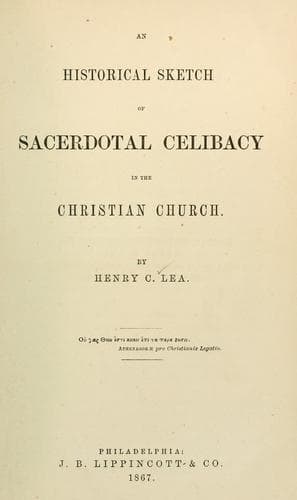
An Historical Sketch of Sacerdotal Celibacy in the Christian ChurchLea, Henry Charles
History
An Historical Sketch of Sacerdotal Celibacy in the Christian Church
Lea, Henry Charles
Catholic Church -- Clergy; Celibacy -- Catholic Church; Church history
It is to this period of darkness that we must attribute the
introduction of sacerdotal marriage, which became so firmly
established and was finally so much a matter of course that it
attracted no special attention, until the efforts made for its
abrogation late in the succeeding century. When Alfred undertook to
restore order in his recovered kingdom, the body of the laws which
he compiled contains no allusion to celibacy, except as regards the
chastity of nuns. The same may be said of the constitutions of Odo,
Archbishop of Canterbury, to which the date of 943 is attributed,
although they contain instructions as to the conduct of bishops,
priests, and clerks[399]—whence we may infer that the marriage even
of consecrated virgins was not uncommon, and that it was the only
infraction of the rule which aroused the opposition of the hierarchy.
Simple immorality called forth an occasional enactment, as in the laws
of Edward and Guthrun about the year 906, and in those of Edmund I.
in 944,[400] yet even to this but little attention seems to have been
attracted, until St. Dunstan undertook a reformation which was sorely
needed.
St. Dunstan himself, although regularly bred to the church, with the
most brilliant prospects both from his distinguished abilities and his
powerful kindred, betrothed himself in marriage after receiving the
lower orders. His uncle, St. Elphege, Bishop of Winchester—apparently
a churchman of the stricter school—vehemently opposed the union, but
Dunstan was immovable in his determination. Elphege, finding his
worldly wisdom set at nought, appealed to the assistance of heaven. His
prayer was answered, and Dunstan was attacked with a mysterious and
loathsome malady, under which his iron resolution gave way. He sought
Elphege, took the monastic vow (the only inseparable bar to matrimony),
and was ordained a priest.[401] This stern experience might have taught
him charity for the weakness of natures less unbending than his own,
but his temperament was not one to pause half-way. If, too, religious
conviction urged him to the task of restoring the forgotten discipline
of the church, worldly ambition might reasonably claim its share in
his motives. He could not but feel that his authority would be vastly
enhanced by rendering the great ecclesiastical body dependent entirely
upon him as the representative of Rome, and by sundering the ties which
divided the allegiance due wholly to the church.
Public-domain text, read in full here on John Shaqi.
Reviews
Reviews
No reviews yet
Be the first to share your thoughts on this work.
Elsewhere in the archive
Join the Discussion
Join the discussion
Sign in to leave a comment or review.
Sign InorCreate an account