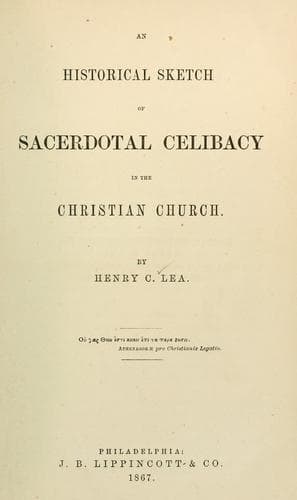
An Historical Sketch of Sacerdotal Celibacy in the Christian ChurchLea, Henry Charles
History
An Historical Sketch of Sacerdotal Celibacy in the Christian Church
Lea, Henry Charles
Catholic Church -- Clergy; Celibacy -- Catholic Church; Church history
Vigor and improvement of modern monachism 611
Its influence in the field of education 616
1880 Suppression of unauthorized orders in France 621
Influence of celibacy on clerical morality 624
Its influence on the social organization 638
NOTE.
On Celibacy as a matter of faith under the Council
of Trent 640
SACERDOTAL CELIBACY.
The Latin church is the great fact which dominates the history of
modern civilization. All other agencies which moulded the destinies
of mediæval Europe were comparatively isolated or sporadic in their
manifestations. Thus in one place we may trace the beneficent influence
of commerce at work, in another the turbulent energy of the rising
Third Estate; the mortal contests of the feudal powers with each other
and with progress are waged in detached and convulsive struggles;
chivalry casts only occasional and evanescent flashes of light amid the
darkness of military barbarism; literature seeks to gain support from
any power which will condescend to lend transitory aid to the plaything
of the moment. Nowhere do we see combined effort, nowhere can we detect
a pervading impulse, irrespective of locality or of circumstance, save
in the imposing machinery of the church establishment. This meets us
at every point, and in every age, and in every sphere of action. In
the dim solitude of the cloister, the monk is training the minds which
are to mould the destinies of the period, while his roof is the refuge
of the desolate and the home of the stranger. In the tribunal, the
priest is wrestling with the baron, and is extending his more humane
and equitable code over a jurisdiction subjected to the caprices
of feudal or customary law, as applied by a class of ignorant and
arbitrary tyrants. In the royal palace, the hand of the ecclesiastic,
visible or invisible, is guiding the helm of state, regulating the
policy of nations, and converting the brute force of chivalry into the
supple instrument of his will. In Central Europe, lordly prelates,
with the temporal power and possessions of the highest princes, joined
to the exclusive pretensions of the church, make war and peace, and
are sovereign in all but name, owing no allegiance save to Emperors
whom they elect and Popes whose cause they share. Far above all, the
successor of St. Peter from his pontifical throne claims the whole of
Europe as his empire, and dictates terms to kings who crouch under
his reproof, or are crushed in the vain effort of rebellion. At the
other extremity of society, the humble minister of the altar, with his
delegated power over heaven and hell, wields in cottage as in castle an
authority hardly less potent, and sways the minds of the faithful with
his right to implicit obedience. Even art offers a willing submission
Public-domain text, read in full here on John Shaqi.
Reviews
Reviews
No reviews yet
Be the first to share your thoughts on this work.
Join the Discussion
Join the discussion
Sign in to leave a comment or review.
Sign InorCreate an account