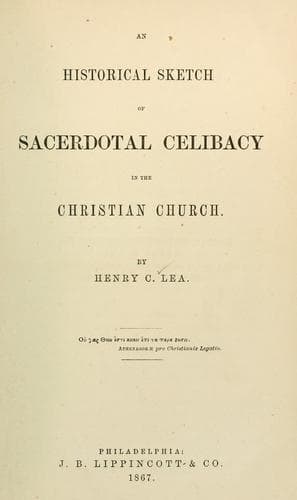
An Historical Sketch of Sacerdotal Celibacy in the Christian ChurchLea, Henry Charles
History
An Historical Sketch of Sacerdotal Celibacy in the Christian Church
Lea, Henry Charles
Catholic Church -- Clergy; Celibacy -- Catholic Church; Church history
In France, the long reign of Robert the Pious seems to have been marked
with almost entire indifference to the subject, but the accession of
his son Henry I. was attended with a strenuous effort to effect a
reform. The council of Bourges, held in November, 1031, but four months
after the death of Robert, may perhaps have been assembled at the
request of the dying monarch, desirous of redeeming his own sins with
the vicarious penance of his subjects. It addressed itself vigorously
to eradicating the evil by a comprehensive series of measures,
admirably adapted to the end in view. Priests, deacons, and subdeacons
were forbidden to have wives or concubines, and all such consorts
were ordered to be dismissed at once and forever. Those who refused
obedience were to be degraded to the rank of lectors or chanters, and
in future no ecclesiastic was to be permitted to take either wife or
concubine. A vow of chastity was commanded as a necessary prerequisite
to assuming the subdiaconate, and no bishop was to ordain a candidate
without exacting from him a promise to take neither wife nor concubine.
Children of the clergy in orders, born during the ministry of their
parents, were pronounced incapable of entering the church, in
justification of which was cited the provision of the municipal law
which incapacitated illegitimates from receiving inheritance or bearing
witness in court; but those who were born after their fathers had been
reduced to the condition of laymen were not to be considered as the
children of ecclesiastics.[439]
Nothing could be more reasonable than all this, considered from the
high-church stand-point, and nothing better adapted to effect the
object in view. All that was wanting was the enforcement of the
legislation—and laws, when opposed to the spirit of the age, are not
apt to be enforced. How much was really gained by the united efforts
of the pope, the emperor, and the Gallican hierarchy can readily be
gathered from a few out of innumerable incidents afforded by the
history of the period.
Public-domain text, read in full here on John Shaqi.
Reviews
Reviews
No reviews yet
Be the first to share your thoughts on this work.
Elsewhere in the archive
Join the Discussion
Join the discussion
Sign in to leave a comment or review.
Sign InorCreate an account