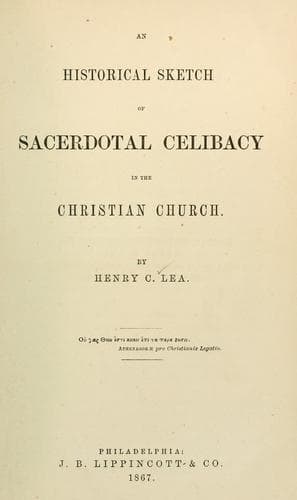
An Historical Sketch of Sacerdotal Celibacy in the Christian ChurchLea, Henry Charles
History
An Historical Sketch of Sacerdotal Celibacy in the Christian Church
Lea, Henry Charles
Catholic Church -- Clergy; Celibacy -- Catholic Church; Church history
The able and energetic, though unscrupulous, Benedict VIII. was no
more, and the great House of Tusculum, which ruled the Eternal City,
had filled the chair of St. Peter with a worthless scion of their
stock, as though to declare their contempt for the lofty pretensions
of the Apostolic Episcopate. A fit descendant of the infamous Marozia
and Alberic, Benedict IX., a child of ten years old at the time of his
elevation in 1032, grew up in unrestrained license, and shocked even
the dull sensibilities of a gross and barbarous age by the scandals of
his daily life.[440] The popular appreciation of his character is shown
by the legend of his appearing after death to a holy man, in the figure
of a bear, with the ears and tail of an ass, and declaring that, as he
had lived in bestiality, so he was destined to wear the form of a beast
and to suffer fiery torments until the Day of Judgment, after which he
was to be plunged, body and soul, into the fathomless pit of hell.[441]
When the Vicegerent of God, the head of the Christian church, was
thus utterly depraved, the prospect of reforming the corruption of
the clergy was not promising, and the good work was not likely to be
prosecuted with vigor.
Nor were the members of the hierarchy unworthy of their superior. We
hear of Rainbaldo, Bishop of Fiesole, who, not contented with numerous
concubines, had publicly married a wife, and whose children were
established as a wide-spread and powerful family—and, what is perhaps
more remarkable, this dissolute prelate was gifted with the power of
working miracles.[442] The bishops, indeed, at this period, were still
rather warrior nobles than Christian ministers. Bisantio, the good
Bishop of Bari, is praised quite as much for his terrible prowess in
battle as for his pious benevolence and munificence; and on his death,
in 1035, his flock chose a military official as his successor.[443]
Public-domain text, read in full here on John Shaqi.
Reviews
Reviews
No reviews yet
Be the first to share your thoughts on this work.
Elsewhere in the archive
Join the Discussion
Join the discussion
Sign in to leave a comment or review.
Sign InorCreate an account