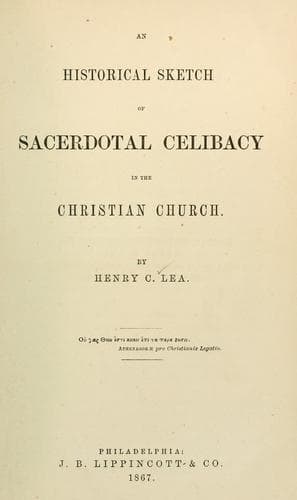
An Historical Sketch of Sacerdotal Celibacy in the Christian ChurchLea, Henry Charles
History
An Historical Sketch of Sacerdotal Celibacy in the Christian Church
Lea, Henry Charles
Catholic Church -- Clergy; Celibacy -- Catholic Church; Church history
Damiani lost no time in stimulating the stranger to the duties
expected of him by the party of reform. From the retreat of Avellana
he addressed to Leo an essay, which is the saddest of all the sad
monuments bequeathed to us by that age of desolation. With cynical
boldness he develops the frightful excesses epidemically prevalent
among the cloistered crowds of men, attributable to the unnatural
restraints imposed upon the passions of those unfitted by nature
or by training to control themselves; and his laborious efforts to
demonstrate the propriety of punishing the guilty by degradation show
how hideous was the laxity of morals which was disposed to regard
such crimes with indulgence.[460] Like the nameless horrors of the
Penitentials, it is the most convincing commentary on the system which
sought to enforce an impossible exaltation of purity on the ministers
of a religion whose outward formalism had absorbed its internal
life.[461]
Leo IX. was not long in manifesting his intentions, and his first point
of attack was chosen with some skill, the ecclesiastical rank of the
victim and his want of power rendering him at once a striking example
and an easy sacrifice. Dabralis, Archbishop of Salona (or Spalatro) in
Dalmatia, was married and lived openly with his wife. Leo sent a legate
to investigate and punish. Called before a synod, Dabralis could not or
deigned not to deny his guilt, but boldly justified it, as the woman
was his lawful wife, and he instanced the customs of the Greek church
in his defence. This only aggravated his guilt, and he was promptly
degraded forever.[462]
Leaving, for a time, the Italian church for subsequent efforts at
reformation, Leo undertook a progress throughout Northern Europe, for
the purpose of restoring the neglected discipline of those regions.
Before the year of his installation had expired, in November, 1049,
we find him presiding with the emperor at a council in Mainz, where
the simony and marriage of the clergy were condemned under severe
penalties.[463] That the influence thus brought to bear had some
effect, at least in externals, is shown by the courtly Albert of
Hamburg, who, on returning from the council to his see, revived a
forgotten regulation of his predecessors, by virtue of which the women
of ecclesiastics were ordered to live outside of the towns, in order
to avoid public scandal.[464] A few weeks before, in France, Leo had
presided over a national council at Rheims, where his vigorous action
against simony caused numerous vacancies in the hierarchy. The records
and canons of this council contain no allusions to the subject of
marriage or concubinage, but it is altogether improbable that they
escaped attention, for they were indulged in without concealment by all
classes of ecclesiastics, and some subsequent writers assert that they
were rigorously prohibited by the council, but that the injunctions
promulgated were unavailing.[465]
Public-domain text, read in full here on John Shaqi.
Reviews
Reviews
No reviews yet
Be the first to share your thoughts on this work.
Elsewhere in the archive
Join the Discussion
Join the discussion
Sign in to leave a comment or review.
Sign InorCreate an account