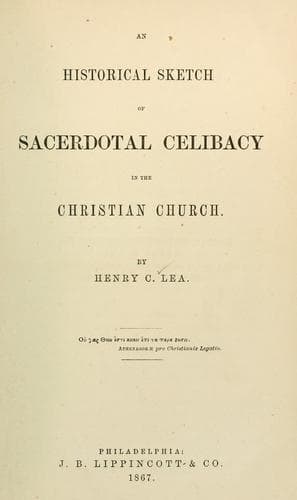
An Historical Sketch of Sacerdotal Celibacy in the Christian ChurchLea, Henry Charles
History
An Historical Sketch of Sacerdotal Celibacy in the Christian Church
Lea, Henry Charles
Catholic Church -- Clergy; Celibacy -- Catholic Church; Church history
Returning to the South, the Easter of 1051 beheld a council assembled
at Rome for the purpose of restoring discipline. Apparently, the
Italian prelates were disposed to exercise considerable caution in
furthering the wishes of their chief, for they abstained from visiting
their indignation on the guilty priests, and directed their penalties
against the unfortunate females. In the city itself these were declared
to be enslaved, and were bestowed on the cathedral church of the
Lateran, while all bishops throughout Christendom were desired to apply
the rule to their own dioceses, and to seize the offending women for
the benefit of their churches.[466] The atrocity of this legislation
against the wives of priests is all the more noteworthy when contrasted
with the tenderness shown to worse crimes committed by men whose high
position only rendered their guilt the more heinous. At this council,
Gregory, Bishop of Vercelli, was convicted of what, by the rules of the
church, was considered as incest—an amour with a widow betrothed to
his uncle. For this aggravated offence he was merely excommunicated,
and when, soon after, he presented himself in Rome, he was restored to
communion on his simple promise to perform adequate penance.[467]
The reformatory zeal of Leo and of the monastic followers of Damiani
was thus evidently not seconded by the Italian church. A still more
striking proof of this was afforded by the attempt to hold a council
at Mantua early in 1053. The prelates who dreaded the result conspired
to break it up. A riot was provoked between their retainers and the
papal domestics; the latter, taken unawares and speedily overpowered,
fled to the council-chamber for safety, and Leo, rushing to the door
to protect them, was in imminent danger from the arrows and stones
which hurtled thickly around him.[468] The reckless plot succeeded, and
the council dispersed in undignified haste. Whether Leo was disgusted
with his want of success and convinced of the impracticability of the
undertaking, or whether his attention was thenceforth absorbed by his
unlucky military operations against the rapidly augmenting Norman power
in Southern Italy, it is not easy now to ascertain: suffice it to say
that no further indications remain of any endeavor to carry out the
reforms so eagerly commenced in the first ardor of his pontificate.
The consistent Damiani opposed the warlike aspirations of the pontiff,
but Leo persisted in leading his armies himself. A lost battle threw
Leo into the power of the hated Normans, when, after nine months, he
returned to Rome to die, in April, 1054, and to be reverenced as a
saint after death by those who had withstood him during life in every
possible manner.[469]
Public-domain text, read in full here on John Shaqi.
Reviews
Reviews
No reviews yet
Be the first to share your thoughts on this work.
Elsewhere in the archive
Join the Discussion
Join the discussion
Sign in to leave a comment or review.
Sign InorCreate an account