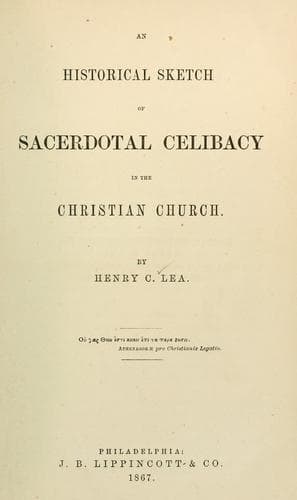
An Historical Sketch of Sacerdotal Celibacy in the Christian ChurchLea, Henry Charles
History
An Historical Sketch of Sacerdotal Celibacy in the Christian Church
Lea, Henry Charles
Catholic Church -- Clergy; Celibacy -- Catholic Church; Church history
Eriberto di Arzago, who filled the archiepiscopal chair of Milan from
1019 to 1045, was one of the most powerful princes of Italy, and
though unsuccessful in the revolt which he organized in 1034 against
the Emperor Conrad the Salic, his influence was scarcely diminished
after his return from the expulsion which punished his rebellion.[502]
At the time of his death, Milan was passing through one of its
accustomed civil dissensions. The Motta, or body of burgesses, had
quarrelled with the nobles and archbishop, and, under the leadership
of an apostate noble named Lanzo, had expelled them from the city—an
ejection which was followed by an unsuccessful siege of three years.
At length, in 1044, Lanzo obtained promise of armed assistance from
Henry III., which reduced the nobles to subjection, and they returned
in peace. Eriberto died the following year, and the election of his
successor caused great excitement. Erlembaldo, the popular chief
(dominus populi), called the citizens together to nominate candidates,
and induced them to select four. One of these was Landolfo Cotta, a
notary of the sacred palace, who was brother to Erlembaldo; another
was Anselmo di Badagio, Cardinal of the Milanese church, subsequently
Bishop of Lucca, and finally, as we have seen, pope, under the name of
Alexander II.; the third was Arialdo, of the family of the capitanei
of Carinate; and the fourth was Otho, another Milanese cardinal. These
four were sent to the Emperor, for him to make his selection; but the
faction of the nobles despatched a rival in the person of Guido di
Valate, who already held the appointment of secretary from the emperor,
and who had recommended himself by zealous services, which now claimed
their reward. Henry gave the coveted dignity to Guido, to the great
surprise and indignation of the popular nominees. Their expostulations
were unavailing, and both parties returned—Guido to assume an office
harassed by the opposition of the people on whom he had been forced,
and the disappointed candidates to brood over the wrongs which had
deprived them of the splendid prize.[503] We shall see how thoroughly
three of those candidates avenged themselves.
It is observable from this transaction that Milan was completely
independent of Rome. The sovereignty of the distant emperor, absorbed
in the dissensions of Germany, could press but lightly on the powerful
and turbulent city. Rome was not even thought of in creating the
archbishop, whose spiritual and temporal power were granted by the
imperial investiture. But when, soon after, the German popes had
rescued the papacy from the contempt into which it had fallen, its
domination over Milan became a necessary step in its progress to
universal supremacy, and lent additional vigor to the desires of the
reformers to restore the forgotten discipline of the church in a city
so influential.
Public-domain text, read in full here on John Shaqi.
Reviews
Reviews
No reviews yet
Be the first to share your thoughts on this work.
Elsewhere in the archive
Join the Discussion
Join the discussion
Sign in to leave a comment or review.
Sign InorCreate an account