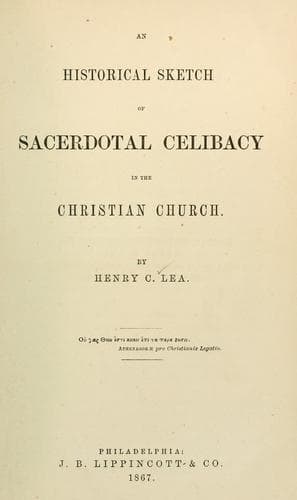
An Historical Sketch of Sacerdotal Celibacy in the Christian ChurchLea, Henry Charles
History
An Historical Sketch of Sacerdotal Celibacy in the Christian Church
Lea, Henry Charles
Catholic Church -- Clergy; Celibacy -- Catholic Church; Church history
must be confessed, of a regard to the duties which man owes to society.
The influences arising from this system of religious philosophy, so
novel to the Semitic races, were tardy is making themselves felt upon
the Hebrews, but they became gradually apparent. The doctrine of a
future life with rewards and punishments, doubtless derived from
Chaldean and Mazdean sources during the Captivity and under the Persian
Empire, slowly made its way, and though opposed by the aristocratic
conservative party in power—the Tsadukim or Sadducees (descendants of
Zadoc, or just men)—it became one of the distinctive dogmas of the
Beth Sopherim or House of Scribes, composed of religious teachers,
trained in all the learning of the day, sprung from the people, and
eager to maintain their nationality against the temporizing policy of
their rulers.[12] At the breaking out of the Maccabean revolt against
Antiochus Epiphanes we find the nation divided into two factions, the
Sadducees, disposed rather to submit to the Hellenizing tyranny of
Antioch, and the Chassidim (the Assideans of the Authorized Version),
democratic reformers, ready for innovation and prepared to die in
defence of their faith. In the triumph of the Hasmonean revolution they
obtained control of the state, and in the development of the Oral Law
by the scribes, supplementing the Torah or Written Law, they engrafted
permanently their doctrines upon the ancestral belief. With the tenet
of spiritual immortality, there followed as a necessary consequence
the subordination of the present existence to life hereafter, which is
the direct incentive to asceticism. The religious exaltation of the
stormy period which intervened between the liberation from Antioch and
the subjugation to Rome afforded a favorable soil for the growth of
this tendency, and rendered the minds of the devout accessible to the
influences both of Eastern and of Western speculation. How powerful
eventually became the latter upon the Alexandrian Jews may be estimated
from the mysticism of Philo.
With their triumph over Antioch, the name of the Chassidim disappears
as that of an organized party, and in its place we find those of
two factions or sects—the Perushim (Pharisees) or Separatists, who
maintained an active warfare, temporal and theological, with the
Sadducees, and the Essenes, mystics, who bound themselves by vows,
generally including the Nazirate, and withdrew from active life for the
benefit of spiritual growth and meditation.
Public-domain text, read in full here on John Shaqi.
Reviews
Reviews
No reviews yet
Be the first to share your thoughts on this work.
Join the Discussion
Join the discussion
Sign in to leave a comment or review.
Sign InorCreate an account