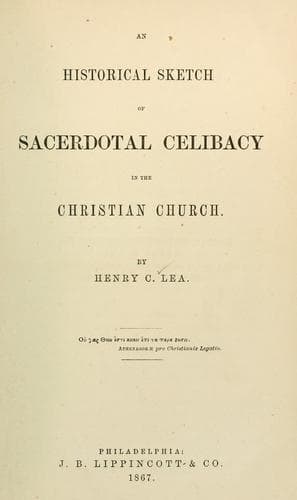
An Historical Sketch of Sacerdotal Celibacy in the Christian ChurchLea, Henry Charles
History
An Historical Sketch of Sacerdotal Celibacy in the Christian Church
Lea, Henry Charles
Catholic Church -- Clergy; Celibacy -- Catholic Church; Church history
The Essenes cultivated the soil and sometimes even lived in cities, but
often dwelt as anchorites, using no artificial textures as clothing,
and no food save what was spontaneously produced. They mostly practised
daily ablutions and admitted neophytes to their society by the rite
of baptism after a novitiate of a year, followed by two years of
probation. Among those who did not live as hermits, property was held
in common, and marriage was abstained from, and it is to this latter
practice doubtless that reference was made by Christ in the text
“There be eunuchs which have made themselves eunuchs for the kingdom
of heaven’s sake.” The Essenes enjoyed high consideration among the
people; their teachings were listened to with respect, and they were
regarded as especially favored with the gifts of divination and
prophecy. There can be no doubt that John the Baptist was an Essene;
James of Jerusalem, brother of Jesus, was a Nazirite and probably an
Essene, and Christ himself may reasonably be regarded as trained in the
principles of the sect. His tendencies all lay in that direction, and
it is observable that while he is unsparing in his denunciations of
the Scribes, and Pharisees, and Sadducees, he never utters a word of
condemnation of the Essenes.[13]
It is thus easy to understand the refined spirituality of Christ’s
teachings, and the urgency with which he called the attention of man
from the gross temptations of earth to the higher things which should
fit him for the inheritance of eternal life. Yet his profound wisdom
led him to forbear from enjoining even the asceticism of the Essenes.
He allowed a moderate enjoyment of the gifts of the Creator; and when
he sternly rebuked the Scribes and Pharisees for imposing, in their
development of the Oral Law, burdens upon men not easily to be borne
by the weakness of human nature, he was far indeed from seeking to
render obligatory, or even to recommend, practices which only the
fervor of fanaticism could render endurable. No teacher before him had
ventured to form so lofty a conception of the marriage-tie. It was
an institution of God himself whereby man and wife became one flesh.
“What therefore God hath joined together let not man put asunder;”
and though he refrained from condemning abstention from wedlock, he
regarded it as possible only to those whose exceptional exaltation of
temperament might enable them to overcome the instincts and passions of
humanity.[14]
Public-domain text, read in full here on John Shaqi.
Reviews
Reviews
No reviews yet
Be the first to share your thoughts on this work.
Join the Discussion
Join the discussion
Sign in to leave a comment or review.
Sign InorCreate an account