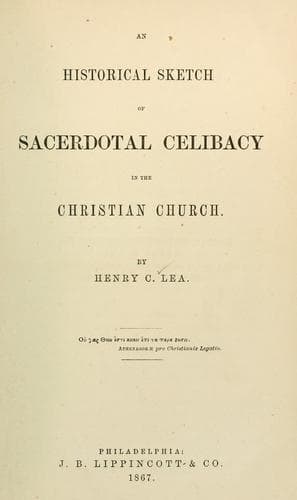
An Historical Sketch of Sacerdotal Celibacy in the Christian ChurchLea, Henry Charles
History
An Historical Sketch of Sacerdotal Celibacy in the Christian Church
Lea, Henry Charles
Catholic Church -- Clergy; Celibacy -- Catholic Church; Church history
Nor was the customary machinery of miracles wanting to stimulate the
zeal of the faithful in this pious work, and to convince the doubters
whose worldly wisdom or humanity might shrink from the task assigned
them. Unchaste priests at Mass would find sudden blasts of wind
overturn the cup, and scatter the sacred wine upon the ground, or
the holy wafer would be miraculously snatched out of their polluted
hands. The saintly virgin Herluca saw in a vision the Saviour, with his
wounds profusely bleeding, and was told that if she desired to escape a
repetition of the horrifying spectacle, she must no longer be present
at the ministrations of Father Richard, the officiating priest of her
convent—a revelation which she employed effectually upon him and his
parishioners. The same holy maiden being observed staring intently out
of the window, declared, upon being questioned, that she had seen the
soul of the priest of Rota carried off by demons to eternal punishment;
and, on sending to his habitation, it was found that he had expired at
the very moment.[553] Puerile as these tales may seem to us, they were
stern realities to those against whose weaknesses they were directed,
and whose sufferings were thus enhanced by every art which bigotry
could bring to bear upon the credulous passions of a barbarous populace.
It cannot be a matter of surprise if men, who were thus threatened
with almost every worldly evil, should seek to defend themselves by
means as violent as those employed by their persecutors. Their cruel
intensity of fear is aptly illustrated by what occurred at Cambrai in
1077, where a man was actually burned at the stake as a heretic for
declaring his adhesion to the Hildebrandine doctrine that the masses
of simoniacal and concubinary priests were not to be listened to by
the faithful.[554] So, in the same year, when the pseudo-emperor
Rodolf of Swabia was elected by the papalists at the Diet of Forcheim
as a competitor to Henry IV., he manifested his zeal to suppress
the heresies of avarice and lust by refusing the ministration of a
simoniacal deacon in the coronation solemnities at Mainz. The clergy
of that city, who had so successfully resisted, for two years, the
efforts of their archbishop Siegfrid to reduce them to subjection to
the canons, were dismayed at the prospect of coming under the control
of so pious a prince, who would indubitably degrade them or compel
them to give up their wives and simoniacally acquired churches. They
therefore stirred up a tumult among the citizens, who were ready to
espouse their cause; and when Rodolf left his palace for vespers, he
was attacked by the people. The conflict was renewed on his return,
causing heavy slaughter on both sides, and though the townsmen were
driven back, Rodolf was forced to leave the city.[555]
* * * * *
Public-domain text, read in full here on John Shaqi.
Reviews
Reviews
No reviews yet
Be the first to share your thoughts on this work.
Elsewhere in the archive
Join the Discussion
Join the discussion
Sign in to leave a comment or review.
Sign InorCreate an account