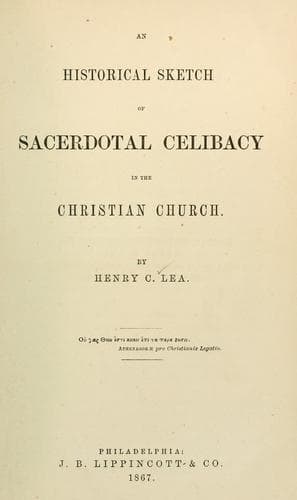
An Historical Sketch of Sacerdotal Celibacy in the Christian ChurchLea, Henry Charles
History
An Historical Sketch of Sacerdotal Celibacy in the Christian Church
Lea, Henry Charles
Catholic Church -- Clergy; Celibacy -- Catholic Church; Church history
This incident affords us a glimpse into the political aspects of
the reform. In the tremendous struggle between the empire and
papacy, Gregory allied himself with all the disaffected princes of
Germany, and they were careful to justify their rebellions under the
specious pretext of zeal for the apostolic church. They of course,
therefore, entered heartily into his measures for the restoration of
ecclesiastical discipline, and professed the sternest indignation
towards those whom he placed under the ban. Thus, after Henry, in 1076,
had caused his bishops to declare the degradation of Gregory, when the
revolted princes held their assembly at Tribur, and in turn decreed
the deposition of Henry, they used the utmost caution to exclude all
who had communicated with Henry since his excommunication, together
with those who had obtained preferment by simony, or who had joined in
communion with married priests.[556] The connection, indeed, became so
marked that the papalists throughout Germany were stigmatized by the
name of Patarini—a term which had acquired so sinister a significance
in the troubles of Milan.[557] In this state of affairs it was natural
that common enmities and common dangers should unite the persecuted
clergy and the hunted sovereign. Yet it is a curious illustration
of the influence which the denunciations of sacerdotal marriage had
exercised over the public mind, that although Henry tacitly protected
the simoniacal and married ecclesiastics, and although they rallied
around him and afforded him unquestionable and invaluable aid, still
he never ventured openly to defend them. Writers both then and since
have attributed the measure of success with which he sustained the
fluctuating contest, and the consequent sufferings of the unbending
pope, to the efforts of the recalcitrant clergy who resisted the yoke
imposed on them by Rome.[558] Yet Henry had formally and absolutely
pledged his assistance when Gregory commenced his efforts, and had
repeated the promise in 1075;[559] and from this position he never
definitely withdrew. Even when the schismatic bishops of his party,
at the synod of Brixen, in 1080, pronounced sentence of deposition on
Gregory, and filled the assumed vacancy with an anti-pope, the man
whom they elected never ventured to dispute the principle of Gregory’s
reforms, although the Lombard prelates, at that very time, were warmly
defending their married and simoniacal clergy.[560] Indeed, Guiberto
of Ravenna, or Clement III., took occasion to express his detestation
of concubinage in language nearly as strong as that of his rival,
although he threatened with excommunication the presumptuous laymen
who should refuse to receive the sacraments of priests that had not
been regularly tried and condemned at his own papal tribunal.[561] In
thus endeavoring to place himself as a shield between the suffering
priesthood and the persecuting populace, he was virtually striving
Public-domain text, read in full here on John Shaqi.
Reviews
Reviews
No reviews yet
Be the first to share your thoughts on this work.
Elsewhere in the archive
Join the Discussion
Join the discussion
Sign in to leave a comment or review.
Sign InorCreate an account