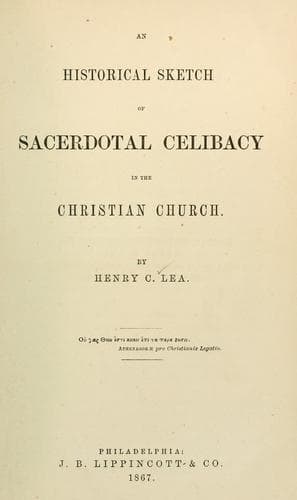
An Historical Sketch of Sacerdotal Celibacy in the Christian ChurchLea, Henry Charles
History
An Historical Sketch of Sacerdotal Celibacy in the Christian Church
Lea, Henry Charles
Catholic Church -- Clergy; Celibacy -- Catholic Church; Church history
Cosmo, who was Dean of Prague, who had been bred to the church, and
had been promoted to the priesthood in 1099, chronicles, in 1118, the
death of Boseteha, his wife, in terms which show that no separation
had ever occurred between them; and five years later he alludes to
his son Henry in a manner to indicate that there was no irregularity
in such relationship, nor aught that would cause him to forfeit the
respect of his contemporaries in acknowledging it.[580] Even more
to the point is the case of a pious priest, his friend, who, on the
death of his wife (“presbytera”), made a vow that he would have no
further intercourse with women. Cosmo relates that the unaccustomed
deprivation proved harder than he had expected, and that for some
years he was tortured with burning temptation. Finding at length that
his resolution was giving way, he resolved to imitate St. Benedict
in conquering the flesh; and having no suitable solitude for the
execution of his purpose, he took a handful of nettles to his chamber,
where, casting off his garments, he thrashed himself so unmercifully
that for three days he lay moribund. Then he hung the nettles in a
conspicuous position on his wall, that he might always have before his
eyes so significant a memento and warning.[581] Cosmo’s admiration for
this, as a rare and almost incredible exhibition of priestly virtue
and fortitude, shows how few were capable of even remaining widowers,
while the whole story proves that not only the clergy were free to
marry, but also that it was only the voluntary vow that prevented
a second marriage. At the close of the century Pietro, Cardinal of
Santa Maria in Via Lata, sent as Legate to Bohemia by Celestin III.,
was much scandalized at this state of affairs; and when a number of
postulants for holy orders were assembled in the church of St. Vitus
at Prague, before ordaining them he pronounced a discourse on the
subject of celibacy and demanded that they should all swear to preserve
continence. Thereupon all the priests who were present rushed forward
and urged them not to assume an obligation hitherto unknown, and when
the Cardinal ordered the Archdeacon to repress their somewhat active
demonstrations, they proceeded to pummel that unhappy official and the
tumult was with difficulty repressed by the soldiery who were summoned.
The legate sentenced some of the rioters to be starved to death in
prison and the rest to be exiled—a wholesome severity which broke
the spirit of the Bohemian priesthood and led to the introduction of
celibacy.[582]
Public-domain text, read in full here on John Shaqi.
Reviews
Reviews
No reviews yet
Be the first to share your thoughts on this work.
Elsewhere in the archive
Join the Discussion
Join the discussion
Sign in to leave a comment or review.
Sign InorCreate an account