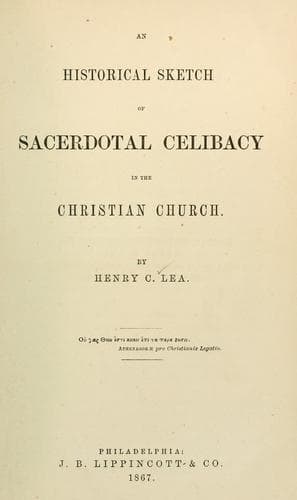
An Historical Sketch of Sacerdotal Celibacy in the Christian ChurchLea, Henry Charles
History
An Historical Sketch of Sacerdotal Celibacy in the Christian Church
Lea, Henry Charles
Catholic Church -- Clergy; Celibacy -- Catholic Church; Church history
That this state of things was not confined to the wild Bohemian
Marches, but obtained throughout Germany in general, is sufficiently
attested by the fact that when Innocent II. was driven out of Rome by
the anti-pope Anaclet, and was wandering throughout Europe begging
recognition, he held, in conjunction with the Emperor Lothair, in
1131, a council at Liége, where he procured the adoption of a canon
prohibiting priestly marriage or attendance on the mass of married
priests. Not only does the necessity of this fresh legislation show
that previous enactments had become obsolete, but the manner in which
these proceedings are referred to by the chroniclers plainly indicates
that it took the Teutonic mind somewhat by surprise, and that the
efforts of Gregory and Urban had not only remained without result, but
had become absolutely forgotten.[583]
If these proceedings of Innocent had any effect, it was only to
make matters worse. The pious Rupert, Abbot of Duits, writing a few
years later, deplores the immorality of the priesthood, who not only
entered into forbidden marriages, but, knowing them to be illegal,
had no scruple in multiplying the tie, considering it to be, at their
pleasure, devoid of all binding force.[584] And in Liége itself,
where Innocent had held his council, Bishop Albero, whose episcopate
commenced in 1135, permitted his priests to celebrate their marriages
openly, so that, as we are told, the citizens rather preferred to give
their daughters in marriage to them than to laymen; and the naïve
remark of the chronicler that the clergy gave up keeping concubines
in secret and took wives openly would seem to show that the cause of
morality had not gained during the temporary restriction imposed by
Innocent.[585] It was not to much purpose that Albero was deprived of
his see for this laxity, for the same state of things continued. No
province of Germany was more orthodox than Salzburg, yet the archdeacon
of the archiepiscopal church there, writing in 1175, bewails the
complete demoralization of his clergy, whom he was utterly unable
to reform. Priests who were content with their own wives and did
not take those of other men were reputed virtuous and holy; and he
complains that in his own archidiaconate he was powerless to prevent
the ordination and ministry of the sons of priests, even while they
were living in open adultery with women whom they had taken from their
husbands.[586] How little sympathy, indeed, all efforts to enforce the
rule called forth is instructively shown by the wondering contempt
with which a writer, strictly papalist in his tendencies, comments
upon the indiscreet reformatory zeal of Meinhard, Archbishop of
Trèves. Elevated to this lofty dignity in 1128, he at once undertook
to force his clergy to obey the rule by the most stringent measures,
and speedily became so odious that he was obliged to leave his
bishopric within the year; and the chronicler who tells the story
Public-domain text, read in full here on John Shaqi.
Reviews
Reviews
No reviews yet
Be the first to share your thoughts on this work.
Elsewhere in the archive
Join the Discussion
Join the discussion
Sign in to leave a comment or review.
Sign InorCreate an account