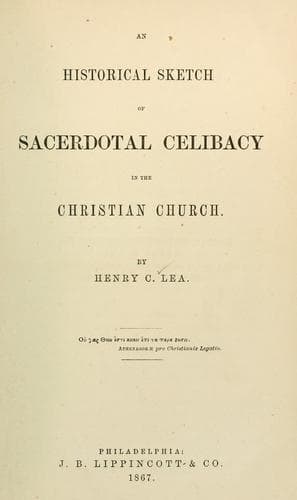
An Historical Sketch of Sacerdotal Celibacy in the Christian ChurchLea, Henry Charles
History
An Historical Sketch of Sacerdotal Celibacy in the Christian Church
Lea, Henry Charles
Catholic Church -- Clergy; Celibacy -- Catholic Church; Church history
has only words of reprobation for the unfortunate prelate.[587]
Even as late as the end of the twelfth century, a chronicler of the
popes, writing in southern Germany, calls Gregory VII. an enforcer of
impossibilities—“præceptor impossibilium”—because he had endeavored
to make good the rule of celibacy;[588] and a council of Ratisbon, in
the thirteenth century, while lamenting the fact that there were few
priests who did not openly keep their concubines and children in their
houses, quotes the canon of Hildebrand forbidding the laity to attend
at the ministrations of such persons, but without venturing to hint at
its enforcement.[589]
* * * * *
Hungary had been Christianized at a time when the obligation
of celibacy was but lightly regarded, though it had not as yet
become obsolete. In reducing the dreaded and barbarous Majjars to
civilization, the managers of the movement might well smooth the path
and interpose as few obstacles as possible to the attainment of so
desirable a consummation. It is probable, therefore, that restrictions
on marriage, as applied to the priesthood, were lightly passed over,
and, not being insisted on, were disregarded by all parties. Even
the decretals of Nicholas II. and the fulminations of Gregory VII.
appear to have never penetrated into the kingdom of St. Stephen, for
sacerdotal celibacy seems to have been unknown among the Hungarians
until the close of the century. The first allusion to it occurs in the
synod of Zabolcs, held in 1092, under the auspices of St. Ladislas
II., and is of a nature to show not only that it was an innovation on
established usages, but also that the subject required tender handling
to reconcile it to the weakness of undisciplined human nature. After
the bitter denunciations and cruelly harsh measures which the popes
had been promulgating for nearly half a century, there is an impressive
contrast in the mildness with which the Hungarian church offered
indulgence to those legitimately united to a first wife, until the
Holy See could be consulted for a definitive decision;[590] and though
marriages with second wives, widows, or divorced women were pronounced
null and void, the disposition to evade a direct meeting of the
question is manifested in a regulation which provided that if a priest
united himself to his female slave “uxoris in locum,” the woman should
be sold; but if he refused to part with her, he was simply to pay
her price to the bishop.[591] Whether or not the pope’s decision was
actually sought, we have no means of knowing; if it was, his inevitable
verdict received little respect, for the Synod of Gran, held about the
year 1099 by the Primate Seraphin of Gran, only ventured to recommend
moderation to married priests, while its endeavor to enforce the rule
prohibiting marriage after the assumption of orders shows how utterly
the recognized discipline of the church was neglected. The consent of
Public-domain text, read in full here on John Shaqi.
Reviews
Reviews
No reviews yet
Be the first to share your thoughts on this work.
Elsewhere in the archive
Join the Discussion
Join the discussion
Sign in to leave a comment or review.
Sign InorCreate an account