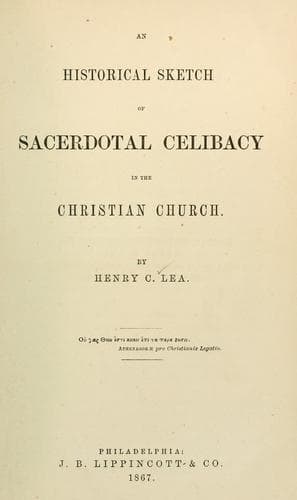
An Historical Sketch of Sacerdotal Celibacy in the Christian ChurchLea, Henry Charles
History
An Historical Sketch of Sacerdotal Celibacy in the Christian Church
Lea, Henry Charles
Catholic Church -- Clergy; Celibacy -- Catholic Church; Church history
The church by this time had gained the position
to which it had aspired, and no longer invoked secular assistance to
enforce its laws. Even Abbot Menco, while admitting the validity of the
popular argument, claimed that such questions were reserved for the
decision of the church alone, and that the people must not interfere.
* * * * *
After thus marking the slow progress of the Hildebrandine movement
in these frontier lands of Christendom, let us see what efforts were
required to establish the reform in regions less remote.
XVI.
FRANCE.
Gregory VII. had not been so engrossed in his quarrels with the Empire
as to neglect the prosecution of his favorite schemes of reform
elsewhere. If he displayed somewhat less of energy and zeal in dealing
with the ecclesiastical foibles of other countries, it was perhaps
because the political complications which gave a special zest to his
efforts in Germany were wanting, and because there was no organized
resistance supported by the temporal authorities. Yet the inertia of
passive non-compliance long rendered his endeavors and those of his
successors equally nugatory.
As early as 1056 we find Victor II., by means of his vicars at the
council of Toulouse, enjoining on the priesthood separation from their
wives, under penalty of excommunication and deprivation of function
and benefice.[612] This was followed up in 1060 by Nicholas II., who
sought through his envoys to enforce the observance of his decretals on
celibacy in France, and under the presidency of his legate the council
of Tours in that year adopted a canon of the most decided character.
All who, since the promulgation of the decretal of 1060, had continued
in the performance of their sacred functions while still preserving
relations with their wives and concubines were deprived of their grades
without hope of restoration; and the same irrevocable penalty was
denounced against those who in the future should endeavor to combine
the incompatible duties of husband and minister of Christ.[613]
In what spirit these threats and injunctions were likely to be
received may be gathered from an incident which occurred, probably
about this time. A French bishop, as in duty bound, excommunicated
one of his deacons for marrying. The clergy of the diocese, keen
to appreciate the prospect of future trouble, rallied around their
persecuted brother, and rose in open rebellion against the prelate.
The latter, apparently, was unable to maintain his position, and the
matter was referred for adjudication to the celebrated Berenger of
Tours. Although, in view of the papal jurisprudence of the period,
the bishop would seem to have acted with leniency, yet Berenger
blamed both parties for their precipitancy and quarrelsome humor, and
decided that the excommunication of a deacon for marrying was contrary
to the canons, unless rendered unavoidable by the contumacy of the
offender.[614]
Public-domain text, read in full here on John Shaqi.
Reviews
Reviews
No reviews yet
Be the first to share your thoughts on this work.
Elsewhere in the archive
Join the Discussion
Join the discussion
Sign in to leave a comment or review.
Sign InorCreate an account