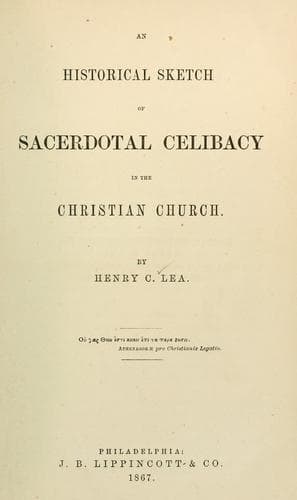
An Historical Sketch of Sacerdotal Celibacy in the Christian ChurchLea, Henry Charles
History
An Historical Sketch of Sacerdotal Celibacy in the Christian Church
Lea, Henry Charles
Catholic Church -- Clergy; Celibacy -- Catholic Church; Church history
Even more significant was the scene which occurred in 1074 in the
council of Paris, where the holy St. Gauthier, Abbot of Ponthoise,
undertook to sustain the decretal by which Gregory VII. prohibited
attendance on the masses of married and concubinary priests. The
assembly manifested its disapprobation of the measure in a manner so
energetic that its unlucky advocate, after being furiously berated and
soundly pummelled, was glad to escape with his life from the hands of
his indignant brethren.[615]
When such was the spirit of the ecclesiastical body, there was little
to be expected from any internal attempt at reform. At the stormy
synod of Poitiers, in 1078, the papal legate, Hugh, Bishop of Die,
succeeded in obtaining the adoption of a canon which threatened with
excommunication all who should knowingly listen to the mass of a
concubinary or simoniacal priest,[616] but this seems to have met with
little response. Coercion from without was evidently requisite, and in
this case, as we have seen, Gregory did not shrink from subjecting the
church to the temporal power. In Normandy, for instance, a synod held
at Lisieux in 1055 had commanded the degradation of priests who resided
with wives or concubines. This was, of course, ineffective, and in 1072
John, Archbishop of Rouen, held a council in his cathedral city, where
he renewed that canon in terms which show how completely all orders
and dignitaries were habitually liable to its penalties.[617] The
Norman clergy were not disposed to submit quietly to this abridgement
of their accustomed privileges, and they expressed their dissent by
raising a terrible clamor and driving their archbishop from the council
with a shower of stones, from which he barely escaped alive.[618] At
length, in view of the utter failure of all ecclesiastical legislation,
the laity were called in. William the Conqueror, therefore, in 1080,
assisted the Archbishop of Rouen in holding a synod at Lillebonne,
where the stern presence of the suzerain prevented any unseemly
resistance to the adoption of most unpalatable regulations. All who
were in holy orders were forbidden, under any pretext, to keep women in
their houses, and if, when accused of disobedience, they were unable
to prove themselves innocent, their benefices were irretrievably
forfeited. If the accusation was made by the ecclesiastical officials,
the offender was to be tried by the episcopal court, but if his
parishioners or feudal superior were the complainants, he was to be
brought before a mixed tribunal, composed of the squires of his parish
and the officials of the bishop. This startling invasion of the dearest
privileges of the church was declared by William to proceed from no
desire to interfere with the jurisdiction of his bishops, but to be
a temporary expedient, rendered necessary by their negligence. Nor
was this remarkable measure the only thing that renders the synod of
Lillebonne worthy of note, for it affords us the earliest authoritative
Public-domain text, read in full here on John Shaqi.
Reviews
Reviews
No reviews yet
Be the first to share your thoughts on this work.
Elsewhere in the archive
Join the Discussion
Join the discussion
Sign in to leave a comment or review.
Sign InorCreate an account