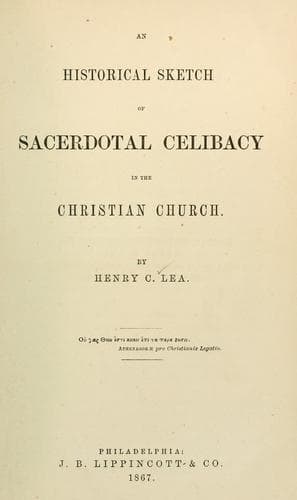
An Historical Sketch of Sacerdotal Celibacy in the Christian Church — John Shaqi
An Historical Sketch of Sacerdotal Celibacy in the Christian ChurchLea, Henry Charles
History
An Historical Sketch of Sacerdotal Celibacy in the Christian Church
Lea, Henry Charles
Catholic Church -- Clergy; Celibacy -- Catholic Church; Church history
When the broad proselyting views and untiring energy of Paul, the
apostle of the Gentiles, were brought to bear upon the little circle of
mourning disciples, it was inevitable that a rupture should take place.
No one in the slightest degree familiar with the spirit of Judaism
at that day can have difficulty in understanding how those who still
regarded themselves as Jews, who looked upon their martyr, not as the
Son of God, but, in the words of Peter, as “Jesus of Nazareth, a man
approved of God among you, by miracles and wonders and signs which
God did by him in the midst of you,” and who held, as is urged in the
Epistle of James, firmly to their Master’s injunction to preserve every
jot and tittle of the Law, should regard with growing distrust and
distaste the activity of the Pharisee Paul, who, like other Pharisees,
was ready to encompass land and sea to gain one proselyte, and, more
than this, was prepared to throw down the exclusive barriers of the
Law in order to invite all mankind to share in the glad tidings of
Salvation.[15] The division came in time, and as the Gentile church
spread and flourished, it stigmatized as heretics those who adhered
to the simple monotheistic reformed Judaism which Christ had taught.
These became known as the Ebionim, or Poor Men, Essenes, and others,
who followed Christ as a prophet inspired by God, who accepted all of
the apostles save Paul, whom they regarded as a transgressor of the
Law, holding their property in common, honoring virginity rather than
marriage, but uttering no precept upon the subject, and observing the
Written Law with rigid accuracy. They maintained a quiet existence for
four centuries, making no progress, but exciting no antagonism save on
the part of vituperative heresiologists, whose denunciations, however,
contain no rational grounds for regarding them otherwise than as the
successors of the original followers of Christ.[16]
Public-domain text, read in full here on John Shaqi.
Reviews
Reviews
No reviews yet
Be the first to share your thoughts on this work.
Join the Discussion
Join the discussion
Sign in to leave a comment or review.
Sign InorCreate an account