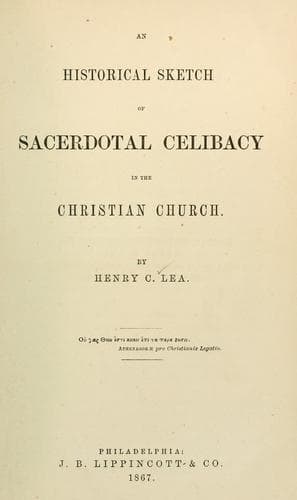
An Historical Sketch of Sacerdotal Celibacy in the Christian ChurchLea, Henry Charles
History
An Historical Sketch of Sacerdotal Celibacy in the Christian Church
Lea, Henry Charles
Catholic Church -- Clergy; Celibacy -- Catholic Church; Church history
Church and state—the zeal of the ecclesiastic and the avarice of the
noble—vainly united to break down the stubbornness of the Norman
priesthood, for marriage continued to be enjoyed as openly as ever. The
only effect of the attempted reform, indeed, appeared to be that when a
priest entered into matrimony he took a solemn vow never to give up his
wife, a measure prompted doubtless by the fears of the bride and her
kindred. The nuptials were public; male issue succeeded to benefices by
a recognized primogeniture, and female children received their fathers’
churches as dower, when other resources were wanting. About the
beginning of the twelfth century, three enthusiastic ascetic reformers,
the celebrated Robert d’Arbrissel, founder of Fontevrault, Bernard
Abbot of Tiron, and Vitalis of Mortain traversed Normandy and preached
with great earnestness against these abuses, the result of which was
that they nearly came to an untimely end at the hands of the indignant
pastors and their more indignant spouses. On one occasion, when Bernard
was preaching at Coutances, a married archdeacon assailed him, with a
crowd of priests and clerks, asking how he, a monk, dead to the world,
presumed to preach to the living. Bernard replied that Samson had
slain his foes with the jaw-bone of a dead ass, and then proceeded with
so moving a discourse on Samson, that the archdeacon was converted, and
interfered to save him from the mob.[622]
If William the Conqueror found his advantage in thus assisting the
hopeless reform within his duchy of Normandy, he had no hesitation
in obstructing it when his policy demanded such a course in his
subject province of Britanny. During the three and a half centuries
through which the Breton church maintained its independence of the
archiepiscopal see of Tours, its metropolis was Dol. Judhaël, who
occupied its lofty seat, not only obtained it by simony, but sullied
it by a public marriage; and when the offspring of this illicit union
reached maturity he portioned them from the property of the church.
This prolonged violation of the canons attracted the attention of
Gregory soon after his accession, and in 1076 he informed William
that he had deposed the offender. William, however, saw fit to defend
the scandal, and refused to receive Evenus, Abbot of St. Melanius,
whom Gregory had appointed as a successor.[623] Judhaël, indeed, was
no worse than his suffragans. For three generations the diocese of
Quimper was held by father, son, and grandson; while the Bishops of
Rennes, Vannes, and Nantes were openly married, and their wives enjoyed
the recognized rank of countesses, as an established right.[624] How
much improvement resulted from the efforts of Gregory and his legate
Hugh may be estimated from the description, in general terms, of the
iniquities ascribed to the Breton clergy, both secular and regular,
in the early part of the next century, by Paschal II. when granting
the pallium to Baldric, Archbishop of Dol.
Public-domain text, read in full here on John Shaqi.
Reviews
Reviews
No reviews yet
Be the first to share your thoughts on this work.
Elsewhere in the archive
Join the Discussion
Join the discussion
Sign in to leave a comment or review.
Sign InorCreate an account