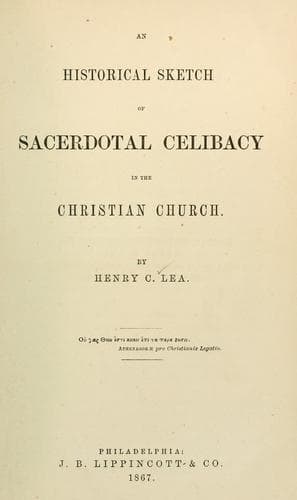
An Historical Sketch of Sacerdotal Celibacy in the Christian ChurchLea, Henry Charles
History
An Historical Sketch of Sacerdotal Celibacy in the Christian Church
Lea, Henry Charles
Catholic Church -- Clergy; Celibacy -- Catholic Church; Church history
The evil influences of this laxity in the Anglican church were not
altogether confined to Britain. At that period the Swedish bishoprics
were frequently filled by Englishmen, and it is quite possible that
from them was derived the laxity which, as we have seen, at a later
period, caused the Swedes to be regarded as heretics adhering to the
Greek schism. An incident occurring about this time shows the wisdom
of the church in her endeavors to sunder the earthly ties of her
ministers. An English priest named Edward was promoted to the Swedish
episcopate of Scaren. Unluckily, he had left a wife behind him in
England, and, after a short residence in his new dignity had enabled
him to collect together the treasures of his see, he absconded with
them to his spouse, leaving his diocese widowed and penniless.[680]
At length the condition of the church in England attracted the
attention of the pontiffs who had bestowed so much fruitless energy
on the morals of the Continental priesthood; and Honorius II. sent
Cardinal John of Crema to England, for the purpose of restoring its
discipline. In September, 1126, the legate held a council in London,
where he caused the adoption of a canon menacing with degradation
all those in orders who did not abstain from the society of their
wives, or of other women liable to suspicion;[681] and the expressions
employed show that previous legislation had been altogether nugatory.
That the cardinal’s endeavors excited the opposition of at least a
powerful portion of the clergy is fairly deducible from the unlucky
adventure which put a sudden termination to his mission. After fiercely
denouncing the concubines of priests and expatiating on the burning
shame that the body of Christ should be made by one who had but just
left the side of a harlot, he was that very night surprised in the
company of a courtesan, though he had on the same day celebrated mass;
and the suggestion that he had been entrapped by his enemies, while it
did not palliate his guilt, may be assumed to indicate the power and
determination of those who opposed his reforms.[682]
Public-domain text, read in full here on John Shaqi.
Reviews
Reviews
No reviews yet
Be the first to share your thoughts on this work.
Elsewhere in the archive
Join the Discussion
Join the discussion
Sign in to leave a comment or review.
Sign InorCreate an account