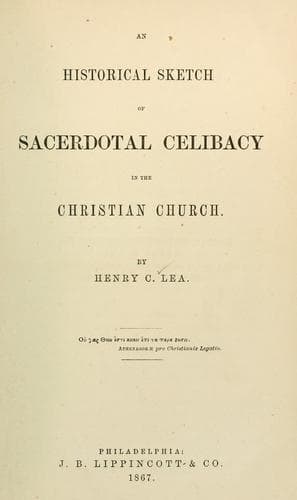
An Historical Sketch of Sacerdotal Celibacy in the Christian ChurchLea, Henry Charles
History
An Historical Sketch of Sacerdotal Celibacy in the Christian Church
Lea, Henry Charles
Catholic Church -- Clergy; Celibacy -- Catholic Church; Church history
The energy of the reformers and the stubborn obstinacy of the clergy
are alike manifested by the council of Westminster, held the following
year, which found it necessary to repeat the prohibition and to guard
it with stringent provisions, based upon those of 1108.[683] This,
however, proved as ineffectual as its predecessors, and another effort
was made the next year under auspices which promised a happier result.
King Henry seemed suddenly to recover the holy zeal which had lain
dormant for a score of years, and in the summer of 1129 he convened
a great assembly of all the bishops, archdeacons, abbots, priors,
and canons of England, who found that they were summoned to meet for
the purpose of putting an end to the immorality of the clergy. After
long discussion, it was decreed that all who should not put away
their wives by St. Andrew’s day (November 30th) should be deprived of
their functions, their churches, and their houses; and the assembly
separated, intrusting to the zealous sovereign the execution of the
decree. Perhaps Henry remembered how St. Anselm had interfered in 1106
to protect the guilty clergy from the royal extortioners; perhaps
the experience of his long reign had shown him the fruitlessness
of endeavoring to impose an impossible virtue on carnal-minded
men. His exchequer, as usual, was in danger of collapse. The whole
transaction may have been a deeply-laid scheme to extort money, or the
sudden promptings of temptation may have been too powerful for his
self-denial—who now can tell? We only know that he at once put into
action an extended system of “cullagium,” and having, by the blind
simplicity of his prelates, the temporalities of nearly all the minor
clergy in his power, he proceeded to traffic in exemptions shamelessly
and on the largest scale. As a financial device, the plan was a good
one; he realized a vast sum of money, and his afflicted priests were at
least able to show their superiors a royal license to marry or to keep
their concubines in peace.[684]
* * * * *
The repetition of almost identical enactments, year after year, with
corresponding infinitesimal results, grows wearisome and monotonous.
If, therefore, I refer to the synod of Westminster, held in 1138, by
the papal legate Alberic, Bishop of Ostia, which deprived of function
and benefice all married and concubinary ecclesiastics,[685] it is only
to observe that no notice was taken of the doctrine of the invalidity
of sacerdotal marriage, which at that period Innocent II. was engaged
in promulgating. So, if I allude to an epistle of Lucius II. in 1144,
reprehending the general English custom by which sons succeeded to the
churches of their fathers, it is merely to chronicle the commencement
of the direct efforts of the popes, fruitlessly continued during the
remainder of the century, to abolish that wide-spread and seemingly
ineradicable abuse.[686]
Public-domain text, read in full here on John Shaqi.
Reviews
Reviews
No reviews yet
Be the first to share your thoughts on this work.
Elsewhere in the archive
Join the Discussion
Join the discussion
Sign in to leave a comment or review.
Sign InorCreate an account