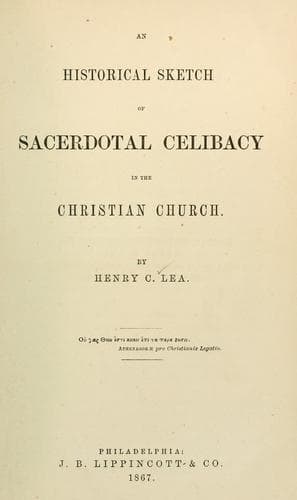
An Historical Sketch of Sacerdotal Celibacy in the Christian ChurchLea, Henry Charles
History
An Historical Sketch of Sacerdotal Celibacy in the Christian Church
Lea, Henry Charles
Catholic Church -- Clergy; Celibacy -- Catholic Church; Church history
No doctor of the church did more than St. Jerome to impose the rule
of celibacy on its members, yet even he admits that at the beginning
there was no absolute injunction to that effect; and he endeavors to
apologize for the admission by arguing that infants must be nourished
with milk and not with solid food.[17] In the middle of the eleventh
century, during the controversy between Rome and Constantinople,
Rome had no scruple in admitting that the celebrated text of St.
Paul (_I. Cor. ix. 5_) meant that the apostles were married, though
subsequent commentators have exhausted so much ingenuity in explaining
it away.[18] A century later Gratian, the most learned canonist of
his time, in the “Decretum,” undertaken at the request of the papal
court, which has ever since maintained its position as the standard
of the canon law, felt no hesitation in admitting that, before the
adoption of the canon, marriage was everywhere undisturbed among
those in orders, as it continued to be in the Greek church.[19] The
reputation of St. Thomas Aquinas as a theologian was as unquestioned
as that of Gratian as a canonist, and the Angelic Doctor admitted as
freely as the canon lawyer that compulsory celibacy was an innovation
on the rules of the primitive church, which he endeavors to explain
by an argument contradictory to that of St. Jerome, for he says that
the greater sanctity of the earlier Christians rendered them superior
to the asceticism requisite to the purity of a degenerate age, even
as no modern warrior could emulate the exploit of Samson in throwing
himself amid a hostile army with no other weapon than a jaw-bone. He
even admits, what other authorities have denied, that Christ required
no separation between St. Peter and his wife.[20] There were in the
thirteenth and fourteenth centuries few more learned men than Giraldus
Cambrensis, whose orthodoxy was unquestioned, and who, as Archdeacon
of St. David’s, vigorously sought to enforce the rule of continence
upon his recalcitrant clergy. Yet in a strenuous exhortation to them to
mend the error of their ways in this respect, he admits that clerical
celibacy has no scriptural or apostolic warrant.[21] That this was
universally admitted at the time is manifested by Alfonso the Wise, of
Castile, about the middle of the thirteenth century, asserting the
fact in the most positive manner, while forbidding marriage to the
priests of his dominions, in the code known as Las Siete Partidas.[22]
Public-domain text, read in full here on John Shaqi.
Reviews
Reviews
No reviews yet
Be the first to share your thoughts on this work.
Join the Discussion
Join the discussion
Sign in to leave a comment or review.
Sign InorCreate an account