An Historical Sketch of Sacerdotal Celibacy in the Christian Church — John Shaqi
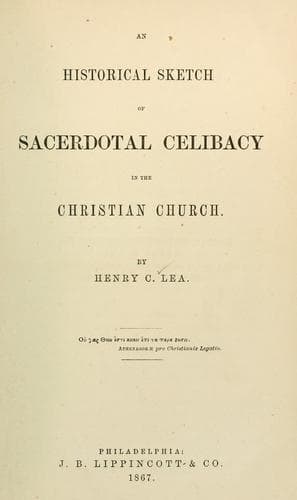
An Historical Sketch of Sacerdotal Celibacy in the Christian ChurchLea, Henry Charles
History
An Historical Sketch of Sacerdotal Celibacy in the Christian Church
Lea, Henry Charles
Catholic Church -- Clergy; Celibacy -- Catholic Church; Church history
Gerson, indeed, who, like most of the ecclesiastics of his time,
attributes to the Council of Nicæa the introduction of celibacy, seems
inclined to justify the change assumed to have been then made, by
alluding to the forged donation of Constantine. That the temporalities
of the church could only be entrusted to men cut off from family ties
was an axiom in his day, and though he does not himself draw the
conclusion, he clearly regarded the supposed accession to the landed
estates of the church as a satisfactory explanation of the prohibition
of marriage to its ministers in the fourth century.[23] Shortly
afterwards, Pius II., one of the most learned of the popes, had no
scruple in admitting that the primitive church was administered by a
married clergy.[24] Just before the Reformation, Geoffroi Boussard,
dean of the faculty of theology of Paris, published, in 1505, a
dissertation on priestly continence, in which he positively assumes,
as the basis of his argument, that the use of marriage was universally
permitted to those in holy orders, from the time of Christ to that of
Siricius and Innocent I.; and this may be assumed to be the opinion
of the University of Paris, for Boussard formally submitted his tract
to that body, and its approbation is to be found in the fact that he
was subsequently elevated to its chancellorship, and was sent as its
delegate to the Council of Pisa.[25]
Even after the Reformation, unexceptionable orthodox authority is
found to the same effect. In 1564, Pius IV. admitted it in an epistle
to the German princes, and explained it by the necessity of the
times.[26] Zaccaria, probably the most learned of Catholic polemics
on the subject, endeavors to reconcile his belief in the Apostolic
origin of clerical celibacy with the indubitable practice of the
primitive church, by suggesting that while the Apostles commanded the
observance of the rule by the clergy in general, yet in special cases
they discreetly dispensed with it to avoid greater scandals; and that
with the gradual increase of these dispensations the clergy came at
length to assume the indulgence as a matter of course without asking
for special licenses.[27] More logical is the argument brought forward
by a priest named Taillard, resisting in 1842 some efforts made to
introduce priestly marriage in Prussian Poland. He coolly reasons that
if celibacy was not enforced in the primitive church, it ought to have
been—“if the celibacy of the priesthood be not from the beginning of
Christianity, it ought to have been there, for, as our holy religion
comes from God, it should contain in itself all the means possible to
elevate the nations to the highest point of liberty and happiness.”[28]
II.
THE ANTE-NICENE CHURCH.
Public-domain text, read in full here on John Shaqi.
Reviews
Reviews
No reviews yet
Be the first to share your thoughts on this work.
Join the Discussion
Join the discussion
Sign in to leave a comment or review.
Sign InorCreate an account