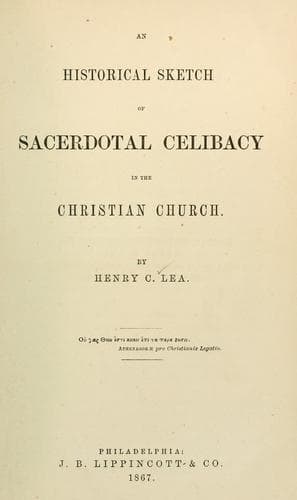
An Historical Sketch of Sacerdotal Celibacy in the Christian ChurchLea, Henry Charles
History
An Historical Sketch of Sacerdotal Celibacy in the Christian Church
Lea, Henry Charles
Catholic Church -- Clergy; Celibacy -- Catholic Church; Church history
Notwithstanding these flights of the imagination, no organized
resistance was offered to the reform. The clergy sullenly acquiesced,
and submitted to a pressure which was becoming irresistible. The
triumph of the sacerdotal party, however, was gradual, and no exact
limit can be assigned to the recognition of the principle of celibacy.
In 1250 the idea of married priests was still sufficiently prevalent to
lead the populace of London to include matrimony among the accusations
brought against Boniface, Archbishop of Canterbury, when his tyranny
had aroused general resistance;[709] and in 1255 Walter Kirkham, Bishop
of Durham, still felt it necessary to prohibit the marriage of his
clergy under pain of suspension and deprivation.[710] It is perhaps
noteworthy, however, that, not long after this, Horne, in his Myrror
of Justice, when treating of exceptions to the benefit of clergy,
specifies second marriages, but not single marriages, as depriving
clerks of the privilege of ecclesiastical trial.[711]
By this time, however, priestly marriage may be considered to have
become nearly obsolete in England. When, in 1268, the Cardinal-legate
Ottoboni held a great national council in London, and renewed the
constitutions of his predecessor Otto, he made no allusion to marriage,
and only denounced the practice of concubinage, which he endeavored to
eradicate by commanding all archdeacons to make a thorough inquisition
annually into the morals of the clergy under their jurisdiction.[712]
These constitutions of Otto and Ottoboni long remained the law of the
English church, and we find them constantly referred to in the canons
of councils and pastorals of bishops, ceaselessly laboring to effect
the impossible enforcement of discipline; even as late as 1399 the
Archbishop of Canterbury ordered his suffragans to have them read
and explained in the vernacular in all their episcopal synods.[713]
How hard was the task may be readily conceived when we see, in 1279,
the primate Peckham, Archbishop of Canterbury, applying to Rome for
assistance in prosecuting a certain bishop against whom he had long
been vainly endeavoring to bring the law to bear. A concubine had
confessed to having borne five children to the offender;[714] he had
himself admitted his guilt in a private interview with Peckham, for
which he had afterwards claimed the seal of the confessional; yet the
archbishop complains that his efforts will be unsuccessful unless he is
fortified with letters from the pope himself. His strict injunctions
of secrecy on his correspondent, and his evident dread lest the
criminal’s agents in Rome should get wind of the application, show how
difficult was the enterprise, and how rarely prelates could be expected
to undertake duties so arduous and so unpromising.[715]
Public-domain text, read in full here on John Shaqi.
Reviews
Reviews
No reviews yet
Be the first to share your thoughts on this work.
Elsewhere in the archive
Join the Discussion
Join the discussion
Sign in to leave a comment or review.
Sign InorCreate an account