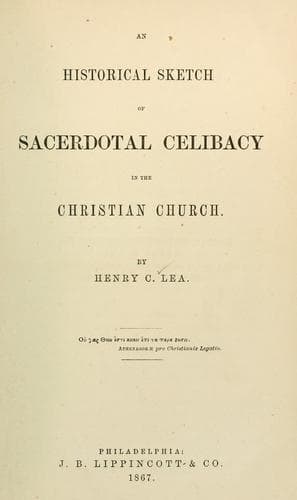
An Historical Sketch of Sacerdotal Celibacy in the Christian ChurchLea, Henry Charles
History
An Historical Sketch of Sacerdotal Celibacy in the Christian Church
Lea, Henry Charles
Catholic Church -- Clergy; Celibacy -- Catholic Church; Church history
Perhaps the man to whom the church owed most for his energy and
activity in promoting the cause of reform was the celebrated Robert
Grosseteste, Bishop of Lincoln. The leading part which he took in the
political troubles of the stormy reign of Henry III. has thrown his
ecclesiastical character somewhat into the shade, and he is better
known as the friend of Leicester than as the untiring churchman.
Notwithstanding his consistent opposition to Henry III. and to the
encroachments of the papacy, he was the inflexible enemy of clerical
irregularities, and he enforced the decretals throughout his diocese
with as firm a hand as that which he raised in defence of the rights
of the nation and the privileges of the Anglican church. Thus, in
1251, he made a rigorous inquisition in his bishopric, forcing all his
beneficed clergy to the observance of the strictest chastity, removing
from their houses all suspected women, and punishing transgressors with
deprivation. It is not easy to approve of his brutal expedient for
testing the virtue of the inmates of his nunneries,[716] the adoption
of which could only be justified and suggested by the conviction that
general licentiousness was everywhere prevalent; and though such
treatment of the spouses of Christ was to the last degree degrading,
yet it was doubtless more efficacious than the ordeal of the Eucharist,
which was frequently resorted to in special cases. Not only, however,
did he thus endeavor to reform the morals of his flock, but he made
the closest scrutiny into the character of applicants for ordination.
In this he was largely aided by his ascetic friend and admirer, Adam
de Marisco, and the correspondence between them shows not only the
importance which they reasonably attached to the subject, but the
sleepless vigilance required to counteract the prevalent immorality of
the clergy, and the incredible laxity with which the patrons of livings
bestowed the benefices in their gift.[717]
Public-domain text, read in full here on John Shaqi.
Reviews
Reviews
No reviews yet
Be the first to share your thoughts on this work.
Elsewhere in the archive
Join the Discussion
Join the discussion
Sign in to leave a comment or review.
Sign InorCreate an account