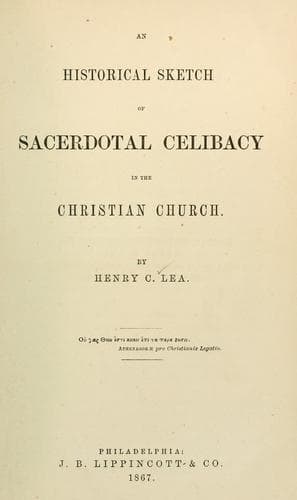
An Historical Sketch of Sacerdotal Celibacy in the Christian ChurchLea, Henry Charles
History
An Historical Sketch of Sacerdotal Celibacy in the Christian Church
Lea, Henry Charles
Catholic Church -- Clergy; Celibacy -- Catholic Church; Church history
The rule was now fairly established and generally acknowledged;
concubinage, though still prevalent—nay, in fact almost universal—was
not defended as a right, but was practised with what concealment was
possible, and was the object of unremitting assault from councils
and prelates. To enter into the details of the innumerable canons
and constitutions directed against the ineradicable vice during the
succeeding half century would be unprofitable. Their endless iteration
is only interesting as proving their inefficacy. A popular satirist of
the reign of Edward II. declares that bribery of the ecclesiastical
officials insured the domestic comfort of the clergy and their female
companions;[718] while in time the canon law seems to have lost all its
terrors. One of the earliest acts of the reign of Henry VII. was a law
empowering the ecclesiastical officials to imprison “priests, clerks,
and religious men” convicted of incontinence, and guaranteeing them
against prosecution by the offenders.[719] That the aid of the secular
legislator should thus have been invoked for protection under such
circumstances showed the audacity resulting from long immunity, and is
the abject confession that the ceaseless labor of four centuries had
utterly failed.
* * * * *
In one part of England, however, the reform seems to have penetrated
even more slowly. We have seen above, on the testimony of Giraldus
Cambrensis, that in the early part of the thirteenth century the
marriage of priests and the hereditary transmission of benefices
were almost universal in Wales. As in the wild fastnesses of the
Principality the ecclesiastical regulations seemed powerless, recourse
was had to the secular law, which was employed to inflict various
disabilities on offenders and their offspring, and the repetition of
these shows how obstinately the custom was adhered to by the clergy
until a comparatively late period. Thus, in the Gwentian and Dimetian
Codes there is a provision that the son of a married priest, born
after the ordination of his father, shall not share in the paternal
estate;[720] and this provision is retained and repeated in a
collection of laws which contains the date of 2 Henry IV., showing it
to be posterior to the year 1400.[721] The same collection enumerates
married priests among “thirteen things corrupting the world, and which
will ever remain in it; and it can never be delivered of them.”[722]
In the same spirit, the Book of Cynog, which is of uncertain date,
declares “nor is a married priest, as he has relinquished his law, to
be credited in law,” and it therefore directs that the testimony of
such witnesses shall not be receivable in court;[723] while another
collection of laws, occurring in a MS. of the fifteenth century,
repeats the provision—“their testimony is not to be credited in any
place, and they are excluded from the law, unless they ask a pardon
from the pope or a bishop, through a public penance.”[724] In fact,
Public-domain text, read in full here on John Shaqi.
Reviews
Reviews
No reviews yet
Be the first to share your thoughts on this work.
Elsewhere in the archive
Join the Discussion
Join the discussion
Sign in to leave a comment or review.
Sign InorCreate an account