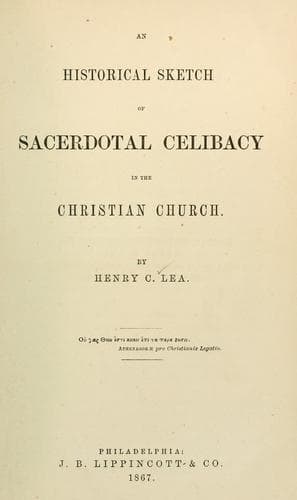
An Historical Sketch of Sacerdotal Celibacy in the Christian ChurchLea, Henry Charles
History
An Historical Sketch of Sacerdotal Celibacy in the Christian Church
Lea, Henry Charles
Catholic Church -- Clergy; Celibacy -- Catholic Church; Church history
we may, perhaps, almost hazard the conclusion that, notwithstanding
the efforts of both ecclesiastical and secular legislators, sacerdotal
marriage scarcely became obsolete in Wales before it was once more
recognized as legitimate under the Reformation.
XVIII.
IRELAND AND SCOTLAND.
In a previous section it has already been shown that the rule of
celibacy was observed by the Celtic churches of the British Islands
during a period in which their Christianity was a model for the rest
of Europe. Their religion, however, could not preserve its purity and
simplicity amid the overwhelming barbarism of those dreary ages. From
an ancient commentary on the “Cain Patraic,” or Patrick’s Law, of
uncertain date, but probably belonging to the ninth or tenth century,
it would seem as though there were at that time two classes of bishops,
one bound by monastic vows, the other permitted to marry; and, what is
somewhat singular, the law appears to favor the latter, for the “cumad
espuc,” or virgin bishop, is condemned to perpetual degradation or to
the life of a hermit for offences which the “bishop of one wife” can
redeem by prompt penance.[725]
The Feini, prior to the advent of St. Patrick, were far in advance of
the contemporary barbarian tribes, and their conversion to Christianity
introduced a new and powerful element of progress. It was not lasting,
however, and they lapsed into a condition but little removed from
that of savages. The marriage-tie was virtually unknown or habitually
disregarded among the laity.[726] What was the condition of the clergy
may be inferred from the fact that the episcopates were regarded as
the private property of certain families in which they descended by
hereditary succession. Thus, in the primatial see of Armagh, fifteen
archbishops were of one house, the last eight of whom were married. At
length Celsus, who died about the year 1130, bequeathed the dignity to
his friend St. Malachi. The kindred rose in arms at this infringement
of their rights, and two of their members successively occupied the
position, which Malachi was not able to obtain until the anger of God
had miraculously destroyed the whole family.[727]
During all this period the Irish church had been completely independent
of the central authority at Rome, but the extension of influence
resulting from the labors of Hildebrand and his successors soon began
to make itself felt. In the quarrels concerning the succession of
Archbishop Celsus, there figures a certain Bishop Gilbert, who is
described as being the first papal legate seen in Ireland.[728] When
Malachi abandoned Armagh and revived the extinct episcopate of Down, he
resolved on a pilgrimage to Rome to obtain the _pallium_, a powerful
instrument of papal authority, until then unknown on the island; and
perhaps the opposition manifested to his wishes by his friends as well
as by the authorities may be attributable to a repugnance towards the
gradual encroachments of Romanizing influence.[729]
Public-domain text, read in full here on John Shaqi.
Reviews
Reviews
No reviews yet
Be the first to share your thoughts on this work.
Elsewhere in the archive
Join the Discussion
Join the discussion
Sign in to leave a comment or review.
Sign InorCreate an account