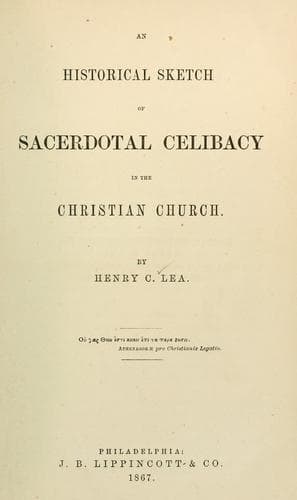
An Historical Sketch of Sacerdotal Celibacy in the Christian ChurchLea, Henry Charles
History
An Historical Sketch of Sacerdotal Celibacy in the Christian Church
Lea, Henry Charles
Catholic Church -- Clergy; Celibacy -- Catholic Church; Church history
Malachi returned from Rome armed with legatine powers, and proceeded
vigorously with the reforms which he had long before commenced. He
held numerous councils, extirpating abuses everywhere, renovating the
ancient rules of discipline and introducing new ones, bending all
his energies to abrogating the national institutions and replacing
them with those of Rome.[730] The earnest asceticism of his nature,
exaggerated by the training of his youth, led him to give a strongly
monastic character to the church of which he was thus the second
founder. On his journey homeward from Rome, he had tarried a second
time at Clairvaux to see his friend St. Bernard, and had left there
four of his attendants to be exercised in the severe Cistercian
discipline that they might serve as missionaries and as models for his
compatriots, who had heard, indeed, of monkhood, but had never seen
it.[731] His efforts, in this respect, were to a considerable extent
successful, at least in a portion of the island, though his death in
1149, at the comparatively early age of 54, cut short his labors before
they could yield their full fruit.[732]
The incongruous character thus imparted to the Irish church is
described by Giraldus Cambrensis some forty years later. The prelates
were selected from the monasteries, and the church was completely
monastic. Chastity was the only rule of discipline thoroughly
preserved, and Giraldus confesses his wonder that it could be
maintained, in contradiction to all former experience, when gluttony
and drunkenness were carried to excess. The monastic principle of
selfishness was all-pervading, and the pastors took no care of their
flocks. Among the people, marriage was still unknown, incest was of
common occurrence, even the rudiments of Christian faith were left
untaught, and the church was regarded without reverence.[733] His
account of the absence of regular stipends and tithes is confirmed
by the fact that an Irish bishop attending the council of Lateran in
1179, in complaining of the condition of his native church, stated that
his only revenues were derived from three milch cows, which his flock
were bound to replace as they became dry.[734] This poverty, however
apostolic in itself, can only, in an age of magnificent sacerdotalism,
be regarded as an indication of a church whose degradation could
command neither the respect nor the support of its children. That
the reforms of Malachi, one-sided as they were, extended only over
a portion of the island, is evident from the inquiry which, a few
years later, the Archbishop of Cashel addressed to Clement III. as
to whether the children of bishops could receive orders and hold
benefices; and the exceptional character of the Irish establishment
was recognized by the pope when he decided that they could, provided
they were born in wedlock, and were otherwise worthy of position.[735]
This requisite of legitimacy was apparently not imposed in ignorance,
Public-domain text, read in full here on John Shaqi.
Reviews
Reviews
No reviews yet
Be the first to share your thoughts on this work.
Elsewhere in the archive
Join the Discussion
Join the discussion
Sign in to leave a comment or review.
Sign InorCreate an account