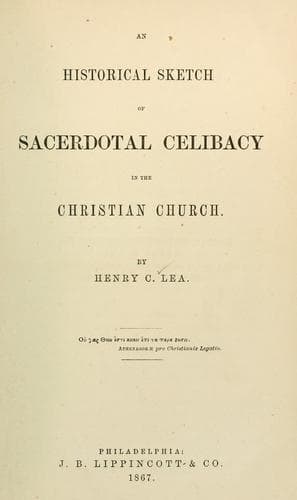
An Historical Sketch of Sacerdotal Celibacy in the Christian ChurchLea, Henry Charles
History
An Historical Sketch of Sacerdotal Celibacy in the Christian Church
Lea, Henry Charles
Catholic Church -- Clergy; Celibacy -- Catholic Church; Church history
Alfonso listened humbly, and professed entire willingness
to repent, but for the difficulty that he had always been taught that
penitence was fruitless without restitution, and restitution he was
unable and unwilling to make. Diego then suggested that he should meet
the chapter and discuss the case, to which he graciously assented. In
the assembly which followed, Diego proposed that the king should follow
the example of his father, Raymond of Gallicia, in commending himself
to the peculiar patronage of Santiago, and in bequeathing his body to
be buried in their church, promising, moreover, that if he should do
so they would pray specially for him, which, from the promise of his
youth, bade fair to be no easy task. Alfonso was delighted to escape
so easily: he eagerly accepted the proposition, and added that he
would like to become a canon of their church, in order to enjoy the
fullest possible share in the Masses of such holy men. To this the
chapter assented at once; he was forthwith duly installed as a canon
of the church which he had just despoiled, and his conscience was set
at rest, while the church felt that it had acquired a moral supremacy
over the spoiler.[762] In thus formally becoming a canon, there could
have been no assumption of celibacy, expressed or implied. Alfonso
was but twenty-one years of age, and in the following year he married
Berengaria, daughter of the Count of Barcelona.[763]
In fact, in the absence of urgency on the part of Rome, the question
of sacerdotal celibacy seems to have been virtually ignored in Spain.
How little importance was attached to the preëminent sanctity of
asceticism becomes evident when we are told that in the whole of
Gallicia there was no convent of nuns until Diego, in 1129, founded
the house of S. Maria of Conjo.[764] Equal indifference is manifested
in the legislative assemblies of the church. The council of Leon and
Compostella, in 1114, only prohibited the residence of such women as
were forbidden by the canons,[765] which, in the existing discipline
of the Spanish church, may safely be presumed to offer no impediment
to the marriage relation; and a synod held at Palencia in 1129 is
even more significant in its reticence, for it merely provides
that notorious concubines of the clergy shall be ejected, without
apparently venturing to threaten any punishment on the reverend
offenders.[766]
Public-domain text, read in full here on John Shaqi.
Reviews
Reviews
No reviews yet
Be the first to share your thoughts on this work.
Elsewhere in the archive
Join the Discussion
Join the discussion
Sign in to leave a comment or review.
Sign InorCreate an account