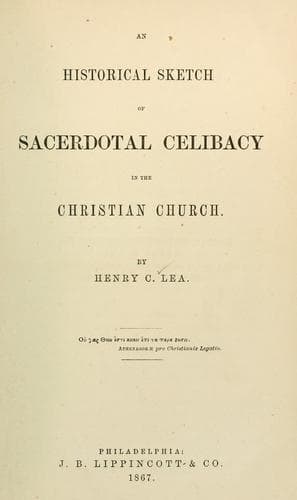
An Historical Sketch of Sacerdotal Celibacy in the Christian ChurchLea, Henry Charles
History
An Historical Sketch of Sacerdotal Celibacy in the Christian Church
Lea, Henry Charles
Catholic Church -- Clergy; Celibacy -- Catholic Church; Church history
Towards the close of his restless life, however, Archbishop Diego
found time, amid his military, political, and ecclesiastical schemes
of aggrandizement, to undertake the much needed reform of a single
monastery. The Abbot of S. Pelayo de Antealtaria was a paragon of
brutish sensuality, who wasted the revenues of his house in riotous
living and took no shame in a numerous progeny. The archbishop
remonstrated with him long and earnestly, both in public and private:
seven times in the general chapter of the diocese he admonished and
threatened the offender without result. At length, in 1130, after
forbearance so remarkable, Diego held a chapter in the abbey for his
trial, when he was proved by competent witnesses to have kept no less
than seventy concubines. He was accordingly deposed, but was so far
from being canonically punished that a benefice in the abbey lands was
assigned for his support. A new abbot was then appointed, who swore to
observe the Benedictine rule as far as he should find himself able to
do so.[767] It is a significant commentary on the state of discipline
and opinion to find so weak an effort to remove and punish the grossest
licentiousness characterized by the biographer of Diego with the
warmest expressions of wondering admiration as a work which doubtless
gave ineffable satisfaction to the Divine Omnipotence, and which was
without example in previous history.
It is very evident that the pontiffs who so energetically enforced the
rule of celibacy throughout the rest of Europe were content to offer
little opposition to the obstinacy of the Celtiberian priesthood.
We can safely conclude, indeed, that matters were allowed to remain
virtually undisturbed, and that the clergy were permitted to retain
their wives. A council held in Gallicia in the early part of the
thirteenth century, for the purpose of reforming ecclesiastical
discipline, preserves absolute silence on the subject of marriage and
concubinage;[768] and, about the middle of the same century, we find
Alfonso the Wise of Castile obliged to formally interdict matrimony to
those in holy orders. In the elaborate code drawn up by that monarch
and known as “Las Siete Partidas,” there is a law punishing sacerdotal
marriage with deprivation of function and benefice; while the wives, if
vassals of the church, are to be reduced to servitude, and if serfs,
are to be sold and the proceeds appropriated for the benefit of the
church of the offender. The wording of the law would seem to indicate
that it was an enactment intended to repress existing disorders, and
not merely a well-known provision inserted in the code for the purpose
of completing a compilation of statutes;[769] while the existence in
secular legislation of such invasions of the province of ecclesiastical
law is a convincing proof of the continued independence of Rome
asserted by the Spanish church and state. The prelates were further
authorized to command the assistance of the secular power in enforcing
Public-domain text, read in full here on John Shaqi.
Reviews
Reviews
No reviews yet
Be the first to share your thoughts on this work.
Elsewhere in the archive
Join the Discussion
Join the discussion
Sign in to leave a comment or review.
Sign InorCreate an account