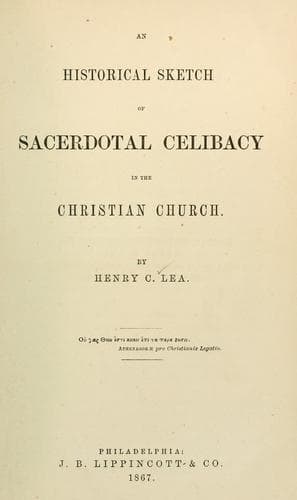
An Historical Sketch of Sacerdotal Celibacy in the Christian ChurchLea, Henry Charles
History
An Historical Sketch of Sacerdotal Celibacy in the Christian Church
Lea, Henry Charles
Catholic Church -- Clergy; Celibacy -- Catholic Church; Church history
these barbarous penalties to their full measure of severity, and this
secular legislation seems to have accomplished what the ecclesiastical
authorities had so utterly failed to effect. After this we hear little
of regular marriage, which was replaced by promiscuous concubinage or
by permanent irregular unions.
In Valencia a council in 1255 prohibited the residence with priests of
all women, except mothers and sisters and such others as were beyond
suspicion, but no penalty was prescribed for infractions of the rule;
and the character of the clergy with whom the council had to deal is
sufficiently shown by its complaint that the priests of the country
parishes frequented the city too much and indulged there in disgraceful
excesses, for which reason it forbids them from visiting the city more
often than twice a month, and requires them to return home the same
day.[770] Arnaldo de Peralta, Bishop of Valencia, not long after,
deplores the utter contempt with which all previous efforts to suppress
clerical concubinage had been received, and the prevalence of the
custom by which ecclesiastics endowed their bastards with the spoils of
the church. Yet the only punishment he finds himself able to threaten
is a fine of thirty maravedis on public concubinarians and of five
on parish priests who connive at such offences or neglect to report
them to the bishop. Ecclesiastics, indeed, are directed to put away
their children, but no penalty is indicated for disobedience.[771]
The council of Gerona in 1257 was more energetic, for it decreed the
deprivation of all concubinary priests who persisted in their sin,
but this apparently was not effectual, for in 1274 the threat was
repeated, with the addition that the women should be excommunicated and
should receive after death the burial of asses;[772] and very similar
was the legislation of the council of Peñafiel in 1302.[773] However
well meant these efforts were, they proved as useless as all previous
ones, for in 1322 the council of Valladolid, under the presidency of
the papal legate William Bishop of Sabina, animadverts strongly on the
indecency of ecclesiastics, from the highest prelates down, officiating
at the nuptials of their children, both legitimate and illegitimate.
For those who publicly kept concubines it provides a graduated scale
of confiscation, ending in the deprivation of the persistently
contumacious who gave no prospect of amendment, the exceedingly
elaborate regulations prescribed showing at once the difficulty of the
subject and the importance attached to it. The acts of this council,
moreover, are interesting as presenting the first authentic evidence
of a custom which subsequently prevailed to some extent elsewhere,
by which parishioners were wont to compel their priest to take a
female consort for the purpose of protecting the virtue of their
families from his assaults. The iniquity of this precaution seems to
have especially scandalized the legate, and he treats the audacious
Public-domain text, read in full here on John Shaqi.
Reviews
Reviews
No reviews yet
Be the first to share your thoughts on this work.
Elsewhere in the archive
Join the Discussion
Join the discussion
Sign in to leave a comment or review.
Sign InorCreate an account