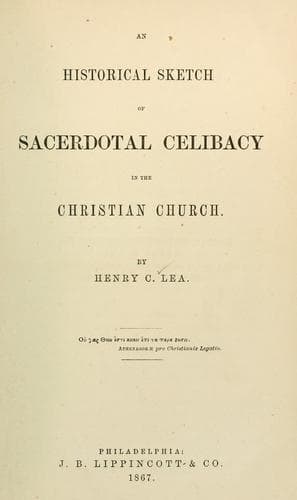
An Historical Sketch of Sacerdotal Celibacy in the Christian ChurchLea, Henry Charles
History
An Historical Sketch of Sacerdotal Celibacy in the Christian Church
Lea, Henry Charles
Catholic Church -- Clergy; Celibacy -- Catholic Church; Church history
laymen concerned in such transactions with much less ceremony than
the concubinary clergy.[774] The elaborate regulations promulgated by
this council produced little effect. The council of Salamanca in 1335
renews the previous repressive legislation, adding a threat of _ipso
facto_ excommunication for those who give Christian burial to priestly
concubines, including all who are present on such occasions, who are
not to be absolved until they shall have paid a fine of fifty maravedis
to the cathedral church.[775] At length, in 1388, a national council
held at Palencia under Cardinal Pedro de Luna, papal legate, made a
determined effort to eradicate the ineradicable vice. It renewed the
regulations of the council of Valladolid, which it stated were not
obeyed, and added to them a clause by which all benefices were held
under a sort of tenure of chastity, and subject to forfeiture. Besides
this, all ecclesiastics who, within two months of death, had kept
concubines, were declared incapable of testating, and their property
was adjudged, one-third to the fabric of their churches, one-third
to the Ordinary of the diocese, and one-third to the fund for the
redemption of captives under the care of the Orders of Trinidad and
Mercede, who were empowered to seize their share. Moreover, all bishops
were commanded to appoint official Visitors, who were to report at
annual synods, to be held thereafter, all cases of infraction of the
rules.[776] The desolation which the enforcement of such regulations
would have wrought may be inferred from the description which a
contemporary, Alvarez Pelayo, Bishop of Silva in Portugal, gives us of
his fellow ecclesiastics. He states that many of the clergy in holy
orders throughout the Peninsula publicly associated themselves with
women, frequently of noble blood, binding themselves against separation
by notarial acts and solemn oaths, endowing their consorts with the
goods of the church, and celebrating with the kindred these illegal
espousals as joyously as though they were legitimate nuptials. Yet even
this flagrant defiance of the canons was better than the wickedness
common between confessors and their penitents, or than the promiscuous
and unrestrained licentiousness of those who were not fettered by the
forms of marriage, whose children, as Pelayo asserts, almost rivalled
in number those of the laity.[777] These excesses were not suppressed
by the council of Palencia. In 1429 the council of Tortosa, under the
presidency of the Cardinal de Foix, papal legate, renewed the lament
that the canons of Valladolid remained unobserved, and in repeating
them it added a penalty of incarceration for pertinacious offenders,
indicating, moreover, one of the worst abuses to which the subject
gave rise, in forbidding all officials to take bribes from those who
transgressed the rules.[778] This effort was as fruitless as all
previous ones had been, and we shall see hereafter that the same state
Public-domain text, read in full here on John Shaqi.
Reviews
Reviews
No reviews yet
Be the first to share your thoughts on this work.
Elsewhere in the archive
Join the Discussion
Join the discussion
Sign in to leave a comment or review.
Sign InorCreate an account